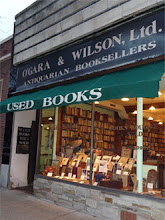
Wednesday, November 28, 2007

Surprises and half-victories!

Hope everyone had a great Thanksgiving! I returned in triumph after the holiday to a half-vanquished Literary Criticism section, so this week's entry will follow a slightly different pattern from the usual. I'm just going to talk about some of the neat things I found in the first half of that section while I was reorganizing it (and marking down most of its contents -- the average price goes from about $5-7.50 for almost all the books therein, now!) Well, I'll just talk about those things after I highlight the most surprising thing in the store this week:


A rack of nice clothing may seem like an unusual thing for a bookstore to be selling, but -- despite concern from our loyal customers -- it's certainly not because the books are selling so badly that we must pawn the clothes off our backs! It seems that a rich gentleman in the Loop became afflicted with a disorder some call "shopaholism", and purchased too much of just about everything -- then never used it. He called us in to deal with his surfeit of books, and sold us hundreds of beautiful editions -- all unread! And as Mr. Wilson was wrapping up his visit, this gentleman said, "Hmm ... would you also like some clothing?"

Doug usually doesn't go for that kind of thing, but the clothing this gentleman had -- everything from Brooks Brothers suits to Ralph Lauren ties -- was so beautiful (and totally unworn!) that he accepted the offer. So now we have a whole bunch of garments of incredible quality, from top designers, all Large or X-Large (shoes about 11), almost all never worn, and all at a fraction of their new price. For instance, that suit hanging in front retails for $1000.00 new, and we're selling it for $350.00 practically new. And not everything is expensive -- we've got $5.00 scarves, $10.00 cotton sweaters, $10.00-15.00 shirts, $75.00 cashmere sweaters ....

Anyway! Back to books. In Literary Criticism, I have discovered an incredible variety of things. I have learned the definition of the word "cucurbit" (because we have a book called Nature and Language: A Semiotic Study of Cucurbits in Literature).* There are many neglected things here that might do better in other sections -- not a day goes past that I don't send some of the books to Anthropology or Women's Studies or some area of regional history. This book is one such:


It more properly belongs in Anthropology, I think (though these categories are often more a matter of art than science!), as it concerns "mask iconography and the role played by masks in the realization of change". Apparently, the author's method is both "historical and comparative". For just $15.00, you can learn all about their uses in "seasonal festivals, rites of passage, and curative ceremonies"!

But Literary Criticism itself is an astonishing repository of randomness:


Here you see (from left to right) ...

1) A brief history of the aphorism! "Starting with the ancient Chinese and ending with contemporary Europeans and Americans, this book tells the story of the aphorism -- the shortest and oldest written form -- through brief biographies of some of its greatest practitioners: Americans like Ambrose Bierce, Emily Dickinson, Mark Twain, and Dorothy Parker; great French aphorists like Montaigne, La Rochefoucauld, and Chamfort; philosophers like Schopenhauer, Nietzche, and Wittgenstein; and prophets and sages like the Buddha, Lao-tzu, and Jesus." $9.00.

2) A 1926 collection of notorious literary attacks! "We need not scoff too much at the curious judgments of reviewers, for every great writer, from Shakespeare down, has had his detractors . ... Reprints of adverse reviews on great writers give consolation to abused contemporary authors." Also, they are often hilarious: one critic of Algernon Charles Swinburne (whose poetical works might be read by clicking here) snaps that "He is so firmly and avowedly affixed in an attitude of revolt against the current notions of decency and dignity and social duty that to beg of him to be a little more decent, to fly a little less persistently and gleefully to the animal side of human nature, is simply to beg him to be something different from Mr. Swinburne. ... It is of no use ... to scold Mr. Swinburne for grovelling down among the nameless shameless abominations which inspire him with such frenzied delight." $12.50.

3) A book analyzing anecdotes! "Recognizing that in America story-telling has been driven off the face of fun by the wisecrack, the joke, and the marvels of mass communication, Louis Brownlow has sought to illustrate the lively and nearly lost art of the raconteur." $5.00.

4) A really nice edition of Holmes' famous The Autocrat of the Breakfast Table, with a slipcase and everything! (Oliver Wendell Holmes was a 19th century doctor and writer, most famous for poems and essays.) $15.00.

5) A discussion of obituaries! "Surveying the darkest corners of Internet chat rooms, surviving a mass gathering of obituarists, and making a pilgrimage to London to savor the most caustic and literate obits of all, Marilyn Johnson leads us to the cult and culture behind the obituary page." $7.50.

6) A book about the "literary, cultural and social history of smoking"! "From the reflections of Sartre and the musings of French Symbolist poets [the author] asks, what is a cigarette? Various war novels, including those of Mailer, Remarque, and Hemingway, frame questions regarding the usefulness of cigarettes in war, their place in a soldier's life, and their function as a tool to manage anxiety .... Photographs that capture the relationship between smoker and smoked or smoker and other are examined. As mediator, weapon, or wand, cigarettes have filled movie screens .... This analysis is laced with glances at the history of cigarette smoking, episodes in its commercial development, and the connections between cigarettes and the currents of sexual and political freedom." $7.50.

Of course, most of Literary Criticism is about, you know, authors -- but there's quite a lot of strange little gems in there. I can't wait to see what I find next week, gentle readers -- and at some point you can expect a Best Of, Part 2!

* The meaning of "cucurbit" used here is "a plant of the gourd family" -- and if you are interested in the book, which is clearly a masterpiece of modern thought, then by God it short and red; $6.50; and resides in the "N" part of Literary Criticism.

Wednesday, November 14, 2007

I want to be like Margaret Anderson when I grow up.

Almost through L in Literary Criticism. I think once I make it through M, I will do a "Best Of The First Half" for that section. There's some amazing things ... like one whole treatise on the "anatomy of the anecdote". Also, if you're a D. H. Lawrence fan, we are the store for you; we have a whole shelf about him!

My Favorite this week is something I discovered in the middle of L:


I thought the name Margaret Anderson was familiar; then I started recognizing names in the Table of Contents, such as that of Alexander Berkman (manager and lover to the charismatic anarchist speaker Emma Goldman) and Ben Hecht (a famous screenwriter who worked on many things, including a 1941 film titled "Lydia" :ahem:). A quick search turned up this site about Margaret Anderson and "The Little Review" (click here), which describes Anderson as a perfectly marvelous woman. Of her, apparently, it was said that "She reminds you of Mary Garden, Isadora Duncan, Lysistrata, Sappho, all packed into one dynamic personality." And apparently extracts of James Joyce's Ulysses were first published in Anderson's magazine (and Anderson arrested on charges of obscenity for publishing it).

And for those interested in anarchist history, Anderson seems to have had some ties with the anarchists on the time, as demonstrated not only by Berkman's name in the table of contents but by the advertisements on the inside back of this magazine:


This covers of this issue are a bit abused, and have detached -- but the text is perfectly clear, and in remarkably good condition otherwise. We're selling this fascinating snapshot of some of the early 1900s' most liberal intellectuals for $20.00.

Also from the 1910s (and earlier) are this week's Collector's Items:


Baedeker started publishing travel guides in the 1870s, and his small-format red books quickly became popular. It's easy to understand, when we look at their lavish fold-out illustrations:


... and maps:


And I'm sure their writing was appreciated, not merely as a guide, but as a description of these faraway and exotic places. The 1890 Southern Italy Baedeker, for instance, talks about lots and lots of frescoes and ruined temples in vivid detail, and reports faithfully on things as mundane as bars:

Continuing to follow the Strada di Mercurio, we next observe ... a Tavern; towards the street is a table covered with marble and a fire-place. A door leads from the shop to the left into a small room adorned with various allusions to drinking: a waggon with a wine-skin, players and drinkers, eatables, etc. In the corner to the left a soldier is being served; above him is scribbled: 'da fridam pusillum' (a glass of cold).

The Southern Italy Baedeker is $50.00; we also have an 1899 Switzerland for $30.00, a 1912 Norway / Sweden / Denmark for $50.00, and several others. Before anyone asks -- we once had one for Paris, but it is long gone. It was really something, though!

To wrap this up, Becka (our newest!) found a great Affordable and Interesting paperback, titled Glen Baxter: His Life. The Years of Struggle. I haven't the faintest idea who Glen Baxter is (though he does seem to have a website -- click here!), but his hilariously illustrated memoirs prove that maxim about a thousand words many time over. He seems to have a fine sense of ironic hyperbole. From the first picture of "one of those long English summer days that seem to go on forever ..."


to the last, of his solemn decision to leave home ...


the whole thing is one long panorama of surreally expressive drawings, and all for $5.00!

There will be no blog entry next week because of the holiday, dear readers -- hope you won't miss us too much. Have a great Thanksgiving. We'll see you again two weeks from now!

Wednesday, November 7, 2007

Here we are in November: cold season, for sure. I've been sneezing violently all day, and I mean violently. I'll drink hot soup tonight. Luckily (or maybe un), the sneezing didn't prevent me from rhapsodizing about one of the best things in the store (the Kipling book featured in our first blog entry ever) ... to a lady who bought it! I am slightly heartbroken, but they do say that if you love something you should let it free.

Our children's books have been a real hit lately. In the scuffle, Alan discovered this and put it in the Affordable and Interesting pile:


It's hard to say when this was printed, because it has no date and the spine's been redone; but the boards and text appear to be a late 1800s copy of "Jackanapes", a Victorian children's tale illustrated by the famous Randolph Caldecott (now known for the Caldecott Award given to children's illustrators). The story is about young Jackanapes, an ill-fated but patriotic hero. The whole is filled with quintessentially Victorian dramatic flourishes, like long dashes and anguished pauses. It's quite sentimental -- reading it is a definite education in Victorian values, complete with a "moral of the story"-type bit at the end that emphasizes "heroic example and noble obligation". I'm not sure how it would be taken by modern children (like the rugrats who took double handfuls of candy last week!), but the illustrations are certainly charming and the whole -- at $4.50 -- might make a good early education in critical thinking.

This week's Collector's Item is a children's book published rather later, but by an equally famous team -- Margaret Wise Brown the writer and Garth Williams the illustrator:


This charming story is considered a classic now; and both writer and illustrator were apparently already famous when it was first issued in 1946, so the ad wizards over at Harper & Brothers had a brilliant idea. As a limited promotion, they released the book in a tiny edition bound in actual rabbit fur:

.


Unfortunately for all concerned, the promotion did not have the desired effect. Small children were expected to be thrilled at the fuzzy book, but they instead reacted with horror and tears. After all, the story is about a happy little furry family -- and the kids realized that the fur covering the book had to come from somewhere! A slight uproar ensued, and the upshot apparently was that the promotional copies were pulled from the shelves and replaced with a more politically correct version. As a result, the fur-bound originals are quite rare. We're selling this one for $695.00; in the past, copies have gone for thousands.

I am not sure whether the "fur-bound book" experiment is reroducible; but my Favorite this week is full of experiments that aren't:


It's important, scientifically, that the results of experiments be reproducible, so we know that they're true. After all, if you can't successfully repeat an experiment that gave a certain result to Tom, there's no evidence that Tom's not lying. But, as this book's Introduction says ...

Why should we close our minds to some of the most ingenious inventions, discoveries and innovations in history just because they fail to come up to an outmoded standard? A new criterion is necessary. So, faced with fascinating findings these brave savants, instead of tediously demanding "is it reproducible?" now boldly inquire "is it funny?"

Article titles include "Decline of Language as a Means of Communication", "Nasality: a Psychological Concept of Great Clinical Significance, Previously Undescribed", and best of all, "Therapeutic Effects of Forceful Goosing on Major Affective Illnesses":


Enough said on that score, I think!

I encourage you all, gentle readers, to do your own unreproducible experiments over the next week, and tell us all about them. Perhaps if you buy this book (at $8.50) you'll get some ideas. In the meantime, I'm going to go try replicating the last experiment's results on my unsuspecting boyfriend. Don't tell him I'm coming, and I'll see you all next week!

Wednesday, October 31, 2007

Happy All Hallow's, gentle readers!

Happy Halloween! Joan came in wearing a blood-stained lab coat and I'm sitting here in a brocade Renaissance gown. We had candy, too, but it went fast (I think a few of the little rugrats took double handfuls while I wasn't looking). (Hey Alessandra, was your male child out tonight in a wizard costume? If so, he came in and said hi -- and was well-behaved, even!)

Anyway, books only this week, I promise. The canes have been going like hotcakes, though -- Doug had to bring in a new batch this week.

I have no idea what kind of lead-in to use for this week's Favorite, so I'll just give the photo first:


We have a pretty small graphic novels section, and I thought I knew pretty much everything that was in there -- until I discovered this graphic novelization of Wagner's Ring Cycle. (In the unlikely event that you have never heard of the Ring Cycle, click here to find out more.) I'm not really one to enjoy opera (believe me, I've tried), but I've often thought that the story of the Ring Cycle sounds stirring and magnificent, and wished that I could get into it. This might be the key! It even boasts an introduction by Brian Kellow of the "Opera News", which notes that "The Norse and Teutonic legends that Wagner took as his source material are chock full of dragons, gnomes, gods and goddesses: certified comic-book material," and asks, "Is there any other composer's work as cinematic as Wagner's?" I wouldn't know, but I do know that I'm tempted by the comic version (at $10.00) ... I'm especially tempted to buy it for my comic-reading boyfriend, but I'm scared that he'd call me a nerd.

I'm also tempted to use this Affordable but Interesting book to design a standard for Brunnhilde:


I really like the phrase "Everything you ever wanted to know about [whatever] but were afraid to ask", partly because it can be hilarious to apply it to obscure things like heraldry. I can't say I ever especially wanted to know anything at all about heraldry, actually ... still, when I open this book at random and start reading, it's hard to stop. Apparently snakes are often heraldically connected to medicine! And look at all the different standard lion poses:


They all actually signify something!

The book has subsections for many individual countries, a bit about heraldry-related laws, and even something on modern applications of heraldry (apparently the Lego headquarters have constructed the local standard entirely from Legos in their front entryway). (This last reminds me of a crazy site I saw a while back [click here], which suggested that we create a heraldic lingo for corporate logos. It's somewhat preposterous, but fun from a design standpoint.) So, if you have any questions on heraldry that you were afraid to ask, they can be answered right here for $15.00.

We've got a few really nice new Collector's Items this week, but I think I'm going to go with this unique one:


Apparently, back in the 1800s, there were many students too poor to afford books they needed for their studies. The solution? Go to the library, of course. But if they really needed the book and couldn't spend all their time in the library, then they'd take a drastic step: they'd copy out the book by hand. So this little black copy-book, which looks like nothing special, actually contains some memoirs of the French Revolution, written out in longhand by some 1820s kid with gorgeous handwriting:


As a calligrapher, I think I could learn a lot from this book, but I think I'll leave it for a French historian (or at least a French speaker). It's the kind of unusual piece that might make a good gift, or would at least send a French Revolution collector into paroxysms of joy -- and only for $125.00. So I feel as though it would be selfish of me to snap it up.

Now it's dark, gentle readers, and time for me to run off to the North Side. This year's Halsted Parade is all about dragons. I'm excited -- with luck, I'll get to battle one!

Wednesday, October 24, 2007

This isn't about books. It's about ...

Back to Literary Criticism. Today I completed the letter H. Victory will be mine! I got a lot of entertainment out of the stuff Doug brought in today and yesterday, though, so I can't complain. Most of it wasn't books -- in fact, almost none of it was books -- so I'm going to do a revolutionary thing with this bookstore blog: there'll be no books on it today! I promise I'll go back to rhapsodizing about books next week, but I just had to talk about these non-books today ...

... before more of them vanish. Earlier, we had far more to talk about: an 1800s jewelry box, a porcelain book-shaped flask. Unfortunately these things were bought so quickly that I hardly registered them. At least we still have the 200-800 A.D. Peruvian textile samples, the late 1800s telescope*, and the following.

Let's start with the Collector's Item:


This old coal-burning stove from the 1850s is still decorated with its original paint, which Doug says is quite rare. While trying to confirm this and find out more about antique stoves from the Internet, I came upon The Antique Stove Hospital's website. At the Hospital, a qualified "paleostovologist" (or perhaps "stove whisperer")** can see to all your antique stove needs. (He's based in Rhode Island, but can refer you to an Indiana stove whisperer if necessary -- perhaps if you buy this stove and decide to get it restored?) The site also tells me that more and more people are buying antique wood- and coal-burning stoves for their original purpose rather than as a historical curiosity. I must admit that this does seem like the kind of thing I would like to have by my side if the Apocalypse comes and all the power grids go out; you too could prepare for such an eventuality for a mere $750.00!

In the Affordable and Interesting corner this week, we have assorted canes!


Having recently secured dozens of wonderful high-quality canes recently, Doug has resolved to bring them in ten or twelve at a time (prices start at $20.00, though some are $30.00 or $40.00). They're dramatic, stylish, and possibly even costume-appropriate for Halloween! This first batch contains some beautifully patterned canes, some uniquely headed canes (one with little frogs!), and one very spiky cane:

.


Doug even mentioned that he managed to acquire a sword-cane! However, he wants to check up on Illinois laws about concealed weaponry before he considers selling it in the store.

Still, though we may never see the sword-cane, I was inspired to read up on various stories of sword-cane derring-do. The most famous appears to be that of James Bowie, an early 1800s gentleman who survived both a gunshot wound and a sword-cane stab to claim victory in a duel and chase his enemies off a sandbar. Ah, such stories stir my red American blood. Perhaps I shall secure my own sword-cane and go on adventures. (If sword-canes turn out to be illegal, I never said that.)

My Favorite might be the sword-cane if we had it, but right now it's this incredibly beautiful piece. I could have spent all afternoon photographing it:


Considered by some to "ground a person and clarify one's version", desert roses apparently form when gypsum-laden water crystallizes in the desert's heat. These mineral formations are so beautiful, I'm astonished that I've never heard of them before.


I like cropping pictures.

One can purchase small desert roses (I didn't see any larger than palm-size) for $5.00 and up at sites like this one (click here), but we didn't find any other examples of such a large and elaborate formation as ours. Its (doubtless magnificent) clarifying properties could be yours for $125.00, though such healthful emotions might be hindered by my envious gaze!

I'm tempted to cover the shadow puppet I mentioned last entry, but I think I'll leave that a mystery (unless you come in and see it, gentle readers!). Don't get into any sword-cane duels accidents, and I'll see you all here next week.

* Over the course of writing this blog entry, someone purchased the 1800s telescope. (I'm not trying to be a tease, really!)

** I did not make these terms up. They're on that site, I promise. The Stove Whisperer also calls his golden retrievers "velocigoldens" and has named them Ptolemy and Magellan. I like him.

Wednesday, October 17, 2007

I'm already excited about Halloween!

The best holiday of the year is coming up: Halloween, for which I just created a window display! I'm very excited about it, though I'm sad that I didn't end up with space to put our new antique Indonesian shadow puppet in the window. I thought its monstrous and elaborate features appropriate for this holiday. Maybe I'll feature it here next week.

One of the Affordable and Interesting things I just put in the window was a (highly Halloween-appropriate) Medieval manual for witch-hunters:


Though first published in the late 1800s, the Malleus Maleficarum is well-known even today, because it influenced witch-hunting for hundreds of years. Written by two inquisitors, it first argues heatedly for the existence of witches, then describes their unholy rituals and discusses what methods may be used to bring witches to justice. (Torture, naturally, is presented as a reasonable -- often necessary -- tool.) One wonders if the inquisitors believed the things they were writing; they sound like scoundrels -- I read on this site (click here), for instance, that they were suspected of embezzling money from the Church and forging notarized documents.

Of course, these activities could be put down to a kind of ends-justify-the-means zeal, a zeal fully demonstrated in many a page of their treatise. But the fact that the two also, for example, take pains to explain that a man of God cannot be harmed by a witch makes me suspect that they were reaching for quick excuses. (Picture this exchange: "If you hunt witches, and witches can really turn men into beasts or worse, then why are you still around?" "Well ... er ... witches cannot affect inquisitors! Yeah, that's it!") I suppose both factors could be somewhat true -- self-rationalization is a powerful backup for zeal -- but naturally, we'll never know quite what they were thinking. We can only guess after their psyches by reading their words (for which we're charging $9.50).

On a religious note, my Favourite thing this week is of a gentler faithful bent:


A facsimile of the beautiful Italian Visconti book of hours, this book suffered an unfortunate accident in the store and lost the cloth on the spine. (A book of hours is a kind of Medieval primer for worship -- a collection of prayers, psalms, and so on that one might use to guide his Catholic devotions. They're so named because all of them contained, among other things, the Hours of the Virgin -- a regimen of prayers and such designed to help Catholics relate to Mary's travails.) The damage is a shame, but then, if the book had never been damaged I would never have looked at it and seen its spectacular pages. All the gold leaf from the original manuscript has been replicated pretty well by a kind of metallic golden ink; the detail of these pictures is amazing, the colors divine.


It was suggested that this book be thrown out because of the damage, but I couldn't bear the idea of that, so I asked Doug to let me slash the price (all the way from $60.00 to $25.00) and try to sell it "merely" for the text. Even though the spine cover's lost, the book is still tightly bound and holds together fine; and the pages are perfect -- they're printed on excellent archival paper and will doubtless record the Visconti Hours for years and years, just as vividly as they do now.

If the theme of this week's entry was Medieval religion, then I will thoroughly break it with this Collector's Item:


I had no idea we had this 1937 telephone directory until today, when I discovered it lurking quietly on one of our rare book shelves. I doubt the phone numbers are any good; I wouldn't even know how to start dialing Glenwd-1849-W or Brdway-1430! -- although the P.G. Wodehouse I've read suggests that it would involve talking directly to an operator rather than actually dialing the number. But some of the advertisements are amazing. It amuses me no end to think about taxis that look like this:


... or a time when extensions to land line telephones were sold individually, considering that today half America's houses have seven extensions and three cell phones. I love the comical expressions of these people, who have apparently come to harm because they didn't have extensions in the kitchen / bedroom:

.


All these advertisements are available in one handy package for $95.00 -- and if you can figure out how to dial the phone numbers, you get those too! But for myself, off I go to continue using my snub-nosed car and comprehensible ten-digit phone numbers. Rest well, gentle readers!

P.S. Jill sends along this note:
Old-timey phone numbers are easy-peasy. The word at the beginning was part of what you dialed -- that's why we have letters as well as numbers on the buttons. Well, they're buttons now, but back in the day they were holes on the dial! Each geographical area had its own "exchange," with its own prefix. Just like now -- here in Chesterton, all the older phone numbers begin with 926. Presumably that stood for something way back when. Now that there are tons more people here, each with his or her own bevy of cell phones etc, we've had to add new numbers beginning with 921, 929, 531, and various others. Those probably don't have anything to do with some primordial township or neighborhood name, but just randomly generated numbers. Click here for a tiny bit of info on the history of phone numbers.

Wednesday, October 10, 2007

Lydia: 1; Entropy: 0

Hello from the depths of the science fiction section! I have been back there shelving new science fiction and reorganizing the whole place for days. On the one hand, it's a break from Literary Criticism ... on the other, I have a really hard time not reading while I work! But now I'm done. This may not be as exciting to you all as it is to me, but I consider it a massive victory against the entropy that constantly besets any good bookshop.

At any rate. My major distraction today actually lay not in the Science Fiction and Fantasy section, but in trying to figure out what was going on in this Affordable and Interesting little pamphlet:


Title: "The Working Wasps: A Historical Drama of No Great Length but Fraught With Much Significance". Of the Vanishing Press, which printed it, this description (click here) is all I can find. Inside the front cover is this somewhat mysterious description:

Paper, we are told, was invented in the first century, in or near China. But what about Prehistory? Are we to suppose that in the decades following the Invention the great warehouses of Canton and Shanghai filled up with paper, awaiting the invention of paper work? No: the egg preceded the chick.

The conceit of the following few-page play appears to be that the Emperor, Empress, and Chamberlain of China have all kinds of paperwork, but must first invent paper to put it on. There are some wryly amusing lines ("Scientists, you know," sighs the Chamberlain, "They did invent the umbrella a few weeks ago."), but the whole appears not intended as a comedy: "A play is a parable, not a monograph," explains the postscript. (I'm not sure what the Chinese characters on every page mean ... was the whole play also translated into Chinese?) Perhaps the moral of the story is supposed to be that people ought to create institutions previous to creating infrastructure for them? Hmmm ... well, I appreciate the typesetting, and while I may buy this (at $3.00) for one of my China-and-irony-obsessed postmodern friends, I think I'll leave it in the shop for a while to give local paper enthusiasts the first crack at it.

Here are some Collector's Items printed on very beautiful paper:


These little art pamphlets are mostly in French, but a few have criticism or poetry in English as well. Doug priced them at $75.00 to $150.00 each, so -- wondering what made them so collectible -- I went and did some research on them. They're lovely, but it turns out that their value comes largely from the collector / gallery owner who printed them: Heinz Berggruen, who died in 2007 (you can read his NYTimes obituary by clicking here). He became a celebrity because of a legendary gesture of generosity.

It seems that, a Jew, Mr. Berggruen fled Germany in his youth and went on to become a great collector; but, several years ago, he sold much of his modern art collection to a German museum at a fraction of its market value. (Germany's museums apparently felt a great lack of modern art, because such work was purged from the country by the Third Reich.) I felt stirred by this story -- the idea of a man who had suffered so much, and the art that had likewise suffered, coming to a kind of reconciliation. If it has a moral, it's that art is above our conflicts, no matter how devastating those conflicts can be.

Perhaps I should have saved the ironic pamphlet for last, just to get the sweetness of that moral out of my mouth! Ick. But I'm afraid this week's Favorite is also beautiful and sappy:


I first picked up the Torch-Bearers trilogy because of the beautiful covers. I assumed them to be science fiction, but it seems that they're actually volumes of scientific history -- in poetic form. As the Introduction says, The story of scientific discovery has its own epic unity -- a unity of purpose and endeavour -- the single torch passing from hand to hand through the centuries; and the great moments of science when, after long labour, the pioneers saw their accumulated facts falling into a significant order -- sometimes in the form of a law that revolutionised the whole world of thought -- have an intense human interest, and belong essentially to the creative imagination of poetry.

Thus, the first volume is a long poem about Copernicus, Tycho Brahe, Kepler, and others; the next two volumes continue the story. Even removing the covers and framing them would be worth the set's price of $60.00, I would think (though I do hope whoever takes these home doesn't abuse them so); but these would be a particularly good gift for a scientist who doesn't lose his appreciation for beauty to hard facts, or a poet who sees beauty even in the spare outlines of science. I find the grandeur of such a poem stirring, myself ....

Ah, it's late. Time to go home now, dear readers -- and don't let my sappiness spoil your dinner!