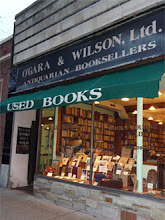
Wednesday, January 23, 2008

Qui me amat, amat et lautitiam meam.

I learned something new about Google today! I was trying to figure out if I had mentioned the Caxton Club on this blog before, and a customer taught me some new operators for use with Google. (An operator is a special kind of keyword that you can use to narrow down your Google search results. I had known some very simple operators, but had not previously thought about more complicated ones.) For instance, I learned about an operator that will find all the sites that link to a given web page: just type "link:[web page name]" into Google -- "link:ogarawilsonbooksellers.blogspot.com" will find all the pages that link to this blog. Another cool operator is the one that will track down all the definitions of a word that you could ever want -- "define:[word]"; for instance, "define:tome" sends you to this page (click here). You can find other very specific Google operators by clicking here.

At any rate, the end result is that I discovered that I've never mentioned the Caxton Club on this blog before. Which brings me, without further ado, to this week's Collector's Item:


The Caxton Club is a venerable club for Chicago book lovers that was started in 1895. The late 19th century was a time in which several excellent book clubs were starting, such as the Grolier Club in New York. Today, many of these clubs still put out beautifully bound books, whose entire production is nurtured along by very dedicated bibliophiles; they also have meetings about fine books and organize exhibitions of their previous beautiful editions. This particular title, Ancient Books and Modern Discoveries, was published in 1927, in a limited edition of 350 copies. It is almost entirely concerned with archaeological discoveries of literature, the materials used to create books, and the histories of those materials. Of course, the book itself is exquisitely made -- vellum, marbled paper, gilt, and lovely type ornaments all abound:


We're selling this Caxton Club treasure for $295.00, and I envy the person whose shelf it will grace. If elegance could kill, my employer would be guilty of murder just for having it around.

I think that this week's Favorite is also elegant in form, though perhaps not in content:


My most recent distraction from Literary Criticism has been the Sociology section, the sorting of which has instilled in me the desire to create two new sections for the store. To wit, these sections are: Crime / Police Work, and Urban Studies. This book will certainly go in the latter section, being a 1945 description of police work. It has a very Hardy Boys attitude towards the whole thing: "The career of a detective is full of thrills," it gushes. "Surely no profession in the world is more exciting or interesting," and jumps from there right into a discussion of what makes a felony vs. a misdemeanor, the powers of a detective, logical deduction, and then the really exciting bits: 1945 forensic science!


Do police still use machines that look like that?

For $15.00 you can learn all about such things as spectroscopes and photomicrographic apparatus. And I think the absolute best part is on page 112, starting with the sentence: "Psychic research is still in a very experimental stage, but in making investigations one occasionally meets with people of psychic personality." I wish I had time to read that whole bit right now, but I must go onwards, so I'll leave you with that teaser, gentle readers!

Our Affordable and Interesting item this week is not especially elegant:


... but not everything has to be elegant, and who doesn't love cowboys? My childhood romantic icon, Zorro, was semi-based on historical cowboys (or at least bandits, the major example being Joaquin Murrieta). Well, I guess there's a difference between bandits and cowboys ... Google tells me that a cowboy is "a hired hand who tends cattle and performs other duties on horseback", which I suppose is different from a bandit in that a bandit steals cattle and performs other duties on horseback. I'm glad we cleared that up.

I feel as though I should read more about cowboys now so that I don't seem so ignorant. I can learn from this "True Cowboy" site -- aha, it has cowboy quotations!

* Never slap a man who's chewing tobacco.
* Always drink upstream from the herd.
* There's two theories to arguing with a woman. Neither one works.
* Never miss a good chance to shut up.


Hmm. I'm not sure this section on cowboys matches the O'Gara and Wilson reputation for erudition, but I'm an urban bookstore girl -- what am I supposed to know about cowboys (beyond Will Rogers quotations, that is)? Maybe I'll buy this pamphlet (at $6.50) and learn some of the songs, so that if a handsome and rugged cowboy rides into my life we'll at least have one thing in common.

If any of you book lovers know anything exciting about cowboys, please do post a comment! In the meantime, I think I'll see if I can rustle up something cleverer to say about cowboys, and present it to you all in my next entry. Surely in a week I can learn something about cowboys other than the image I've been fed by popular culture ... let's find out next week, gentle readers!

Wednesday, January 16, 2008

Qui me amat, amat et Thurberem meam.

Ah, gentle readers, this week I have a nostalgia trip first and foremost. The Favorite brings me back to childhood, when I spent all my time curled up reading in unlikely places. I often sat directly over a heating vent. I also enjoyed lurking under the kitchen table. Sometimes I built cushion forts and read while sitting in those.

What reminds me of childhood, you ask? This:


I can't quite recall when I discovered James Thurber, but I do believe The Thirteen Clocks was the first book of his that I read. It amazed me with its eccentric and exuberant humor. I discover from this biography (click here) that much of this eccentricity comes from his mother:

Mary Thurber was a strong-minded woman and a practical joker. Once she surprised her guests by explaining that she was kept in the attic because of her love for the postman. On another occasion she pretended to be a cripple and attended a faith healer's revival, jumping up suddenly and proclaiming herself cured. Thurber described her as "a born comedienne" and "one of the finest comic talents I think I've ever known."

This First Edition of The Thirteen Clocks features glorious illustrations by Marc Simont:


As for an actual description of the book ... well, I can start by saying that I tend to feel slightly irritated by most comic fantasy. The Princess Bride is a fine work, as is Patricia C. Wrede's more recent Dealing With Dragons, and many things Terry Pratchett has written; but most comic fantasy follows the same tired tropes, and has all the same self-conscious, contrived elements. The Thirteen Clocks is comic fantasy that's not only far, far better than those tropes -- it's completely different from everything I mentioned above. It involves a prince seeking the hand of a princess, etc., but in its self-consciousness and random asides, it's charming and ironic rather than tired. If you've never read it, you're in for a treat -- and if you already love it, then how can you resist buying this excellent copy (at $40.00)? Did I mention that this is not only the First Edition, but the thirteenth printing?

All right, I've rambled on about my childhood enough. Time to showcase some early 1900s nostalgia instead, with this week's Collector's Item:


Stereography is one of those technologies that, with the advent of film, quickly fell out of favor (I was surprised to see that there are still stereography devotees, and even websites devoted to stereography!). Back in their day, stereoscopes were a wildly popular method of viewing faraway vistas or other exotic things. The viewer would hold the stereoscope before his eyes like this:


... and insert one of the cards into it:


When viewed through the viewer, the cards have a sort of pop-out effect, creating a limited three-dimensionality. And each of the cards has a long description of the scene it's portraying on the back; for instance, the Campanile Doge's palace and prison card from Venice starts with, "We are on a broad lagoon," and goes on to spend three paragraphs talking about the canals of Venice, the general appearance, and the history of the buildings on the card.

Here in the store, we sometimes sell stereoscope cards on their own, but in this case we've got a full set plus viewer on our hands. We've even got a 1926 book that goes with it:


The book would be better titled In Praise of the Stereoscope, as it mostly discusses the invention of marketing of said item, but it does have a bunch of card captions. And the red pamphlet is three maps -- one of New York, one of Washington D.C., and one of the world -- all in beautiful condition despite their age, and all intended to help stereographers find the locations on the cards.

We're selling all these things together, for $200.00. The 113-card collection, as you can see from the "spines" of the faux-book card case, is themed "Tour of the World" -- how very Victorian -- and each card provides a landmark like Westminster Abbey, or an everyday scene like the gondolas in Venice, or an exciting ruin from faraway lands. Well, I suppose Westminster Abbey is "faraway lands" for us Americans, but ... onward to the next item.

That is, this Affordable and Interesting pamphlet, somewhat utopian and hilariously titled:


Lorenz Stucki has Views (I think the capital V expresses his seriousness) on how humanity has undone itself with modern society. He first writes a paean to a potential world full of robots, where no one might need to work and everyone might pursue the arts, then sighs that modern society is so obsessed with work that we are unable not to work. In fact, when we aren't working, we become neurotic horrible people, or aimless and depressed! He blames society for this, and concludes that though we ought to create a high-leisure society, we also ought to properly educate its members such that they spend their time doing the Right Things: art, obviously, along with the refining of our virtues. (Stucki doesn't really explain what this latter part means.) I would like to believe that humanity, given nothing but leisure, would spend all its time on art if "properly educated" to do so, but I suspect that equal portions of time would be devoted to gossip and beer. Of course, I could be wrong. Or we could elevate beer and gossip to an art form ... that works too, I suppose. Buy the pamphlet and form your own Stuckian theories for $6.00! *

Well, I'm off to dinner. Maybe I'll refine the art of gossip while I'm there. You do your part, gentle readers, and perhaps we can write a manifesto for the gossip movement next week!

* In the incredibly unlikely event that Lorenz Stucki reads this: Dear sir -- this is all in fun, and no offense is intended.

Wednesday, January 9, 2008

Qui me amat, amat et felem meam.

It's been quite a week! We hired someone new, Shelley, and she and I have been slowly battling my old foes Chaos and Entropy by means of section-by-section team cleanup. We went through Reference and Germany like white lightning; I am proceeding with General History / Historiography, which is almost as much of a hodge-podge as Reference was. But don't think my nemesis Literary Criticism is forgotten. Oh, no. I left in the middle of P, and it awaits my return like a malevolent creature of doom.

We moved many of the hodge-podgier elements of Reference to more relevant sections. (Classifying books is always more an art than a science; I can see what would lead someone to put the Jazz Dictionary in Reference, though I deemed it better in Music.) I had originally intended to feature a book of charming and miscellaneous Latin phrases here, but I made the mistake of showing it to some of my favorite customers -- and they bought it before I could share it with you, gentle readers! * So, all in a flurry, I've just changed this week's Affordable and Interesting item:


It seems as though left-handed people feel a lot of anxiety about it. I mean, I'm not left-handed myself, but my best friend at age 7 was, and she was always going on about it. Those of us who are right-handed don't really notice, I think, until we are confronted by books like this one. Paging through it was like peering into another world! It has sections about the history of left-handedness, lefty organizations to join, and the differences between the very brains of righties and lefties. There's even a bit on "Are You Sure You're a Lefty?", as if to assure us righties that someone would actually care enough to pretend to leftyhood. This does seem like it would be a charming book for parties -- chock-full of ridiculous facts, like the Guinness Book of Records, but better. You could wow all your friends for $5.00!

Imagine what saying things in Latin says about you. Probably not as much as looking at inkblots would. You could discover for yourself with this week's Collector's Item:


I feel obliged to describe the Rorschach test, though I'm guessing most of you know what it is -- or have even undergone one (I have! I kept seeing a winged image that I thought of as the butterfly featured in chaos theory). It is designed to analyze subjects' psyches by having them look at inkblots:


Whatever a person sees (or imagines) in the inkblots hypothetically says a lot about her personality. These particular Rorschach plates are from the 1940s; they're sturdy -- they've held up well -- and they are the very ones that belonged to Erika Fromm, a psychologist well-known for promoting the use of hypnosis in therapy. For $250.00, you can not only learn uncountable things about your mind and those of all your friends; you can also enjoy the knowledge that you're following in Fromm's wise footsteps! We won't hypnotize you into buying the cards if you just want to stop by and do some on-the-go psychoanalysis, though.

I feel as though I can I somewhat understand the psychology behind the Rorschach test. This week's Favorite, however, seems outside my sphere:


"Only a general regard for the Soviet Government as 'an enemy of mankind' and relentless opposition against it can insure the failure of the vicious undertakings by which it aims to destroy the present political and moral principles of civilized nations." So ends World Wide Soviet Plots, a circa 1929 book detailing conclusions drawn from documents that were apparently seized from the Soviet Socialist Military Attache in Peking. It starts with a discussion of the various pseudonyms used by the writers of said documents, progresses through an analysis of the politics of the Soviet Socialist Republic and China in the context of said documents, and ends with terror and hysteria. After all, N. Mitarevsky exclaims, these documents do conclusively establish that "Soviet authorities do not recoil from any methods and that they resort to agitation, bribery, violence, terror and all varieties of crime in seeking their purpose."

This book is a bit beat up -- perhaps it was smuggled somewhere in harsh circumstances? -- and very scarce. In fact, I wasn't able to find any other copies available on the Internet -- was it not only smuggled, but suppressed? I don't feel qualified to judge the soundness of its ideas (though you could for $60.00), but I am quite interested in its alarmist tone and attitude of scandalous secrecy. If I'm never seen again after posting this entry, gentle readers, you will all know why!

I'll leave you with that comforting thought. Enjoy the 56-degree weather, fellow Chicagoans! I'm sure we'll be punished with 4 degrees again soon enough.

* My description of said book went like this:
I almost feel as though I should save Amo, Amas, Amat and More for Alan (you may have noticed his utterly gratuitous use of Latin in the entry he wrote), but let's give our loyal customers a crack at it first. The subtitle, "How to Use Latin to Your Own Advantage and to the Astonishment of Others", does a great job of summing this book up (although I am personally unsure of how much advantage one derives from quoting a Latin saying if no one else knows what it means). However, it is highly amusing to think about quoting exceptionally common English sayings in Latin, such as "Qui me amat, amat et canem meam" ("Love me, love my dog") or "Rem acu tetigisti" ("Right on").

I liked it too much to delete it entirely. And maybe some of you will glance around another bookstore for it, since we don't have it anymore!

Wednesday, January 2, 2008

4 degrees today, 56 this weekend. I love Chicago!

Let's welcome the American Philological Association to Chicago! A gentleman came in today and remarked that there were lots of classicists in town, so tomorrow Doug and I will be putting out a whole bunch of Classics material, for the delectation of all.

Happy New Year, everyone! I, Lydia, have returned. I don't know about you, but my desolate time away from the store was brightened by Alan's first blog entry of two weeks ago. * Go Alan! (I'll rope him into doing more blog entries -- soon, yes, sooooon. You mark my words.)

But for now, the blog is up to me, with my obscure and oft-bizarre tastes. Take, for instance, this week's Favorite:


These days, our "pillars of society" get multimillion-dollar book deals and write long tell-all autobiographies. Back in 1916, I suppose said pillars found that less interesting than other pursuits, so random people had to write about them instead. Or perhaps there weren't quite the same kind of invasive scandal magazines that we have now ... though I find that rather unlikely. At any rate, a Mr. A.G. Gardiner apparently found a market for a book that synopsizes the lives of various well-known contemporaries. These include many people I have heard of -- Mr. Roosevelt, King George V, Mr. Andrew Carnegie, Sarah Bernhardt, Prince Kropotkin, Mr. Churchill, Mr. H. G. Wells -- and many I have not -- Archdeacon Lilley? Mr. Asquith?

I wonder if all the names I don't recognize demonstrate lamentable ignorance on my part, or if these people are the 1916 equivalent of Britney Spears (who will no doubt be forgotten eighty years from now). Regardless, this book makes a fine compilation of anecdotes about various figures who were famous in 1916 (apparently King George V was raised as a sailor!) ... not to mention snippy backhanded side notes ("But with all his boisterous courage and frank hilarity, [Mr. Roosevelt] cannot be acquitted of sharp practice of the most flagrant sort."), all of which can be yours for $9.00.

My obsession with fonts and calligraphy would convince me to buy this week's Collector's Item if I had the wherewithal:


This beautiful limited edition (copy #73 of 115) is essentially a bunch of "visual interpretations" of Emily Dickinson. Almost every page is remarkable enough to give me pause. The design is spare and elegant, but vivid; some pages have illustrations:


... but many concentrate on a lovely page-border, or the perfect font. Some even do interesting things with the fonts' very orientation:


I have never been Emily Dickinson's biggest fan, but I even I was impressed by the way her poems fit with these designs. I spent quite a while admiring each page; I can only imagine the joy a Dickinson lover would gain -- all for $175.00!

When I returned from vacation, I found nine lovely Affordable and Interesting books in the window that I had never seen before:


These books, each about one particular decorative art, have quite a lot of color photographs. They distracted me for quite a while, especially the one on posters -- everyone loves bullfights!:


... and the one on 1920s style:


Can you imagine living in that room? I'd feel as though I was sleeping in a wedding cake.

My sharp eye for political incorrectness detected some 1960s-style social commentary in here (for instance, the book on Chinese painting talks a bit about the mysterious East -- hello, Edward Said!). People tell me sometimes that one of the great things about this blog is all the pictures, though, and I think these books are the same way -- just as you can take or leave my nattering here, you can take or leave these books' meandering discussion. There's 60-80 photos per book and each book is $7.50, so per picture that's a pretty good deal! I didn't get nearly as good a deal on my art textbooks in college.

Well, that's a wrap on our first entry for the year. Don't let January get you down -- it may be frigid now, but it's supposed to be a whopping 54 degrees this weekend!

* It wasn't really desolate. I had a lovely time over the holidays. (Hi Mom!)

Wednesday, December 19, 2007

Roman-Capitalist Mystics

Let me first say what a privilege it is to fill the shoes of my inspired co-worker Lydia. She is a triumphant force of nature, single-handedly pumping the virtual bellows that powers O’Gara and Wilson’s electronic existence. I guess double-handedly, actually, since the virtual bellows is our keyboard, and one pumps a keyboard by typing, which requires two hands. My apologies for making the metaphor explicit. Lydia probably wouldn’t have done so, being skilled in the art of rhetoric, and humble enough to revise. Indeed, her flair for writing is matched only by the beauty of her penmanship, which is reason enough to visit our store.

But enough with the niceties. MY name is Alan, and though I have never written a blog entry before, it is my sincerest hope that this one will be successful. That is to say, I hope to avoid offending people, and inspire them to purchase things. A meager definition of success, perhaps, but such meager definitions are crucial for keeping one’s success constant.

The Confucian aspect of my training at the divinity school is now reminding me that success is also contingent upon respect for tradition. So, without further ado, allow me to present this week’s Affordable but Interesting item:

I’m sure most readers of this blog, insofar as they are educated, are already fervent supporters of laissez-faire capitalism. But for those who have not yet been awakened to the truth about free-market consumption, you may want to read “How We Live,” a hardbound 1944 manifesto on the indubitable and inexhaustible advantages enjoyed by a consumer culture. Never fear the specter of propaganda, my friends! The authors assure us on page one that “there is, in this book, not a single opinion, not a single word of praise or condemnation.” The graphics, needless to say, are all in keeping with this claim. Our kind and even-handed explicators of the economic process exhort us: “It must be remembered that harmful, uncontrolled monopolies cannot exist as long as the customer is free to buy from whomever he pleases.” And they observe that “disemployment and hardships are caused by one large group securing advantages over other groups, and that those who suffer most are to be found in the group that supposedly has the advantage.” Common sense, to be sure, but everyone can use a refresher course. And a cheap one at that -- $12.50 Give thanks to our consumer culture for driving down the price.

The previous paragraph is, in fact, intended to be somewhat tongue-in-cheek. Just making sure.

We turn now to a man who wrote with his tongue far, far, far away from his cheek. Thomas à Kempis was a Roman Catholic monk, best known for his devotional work “The Imitation of Christ,” which is this week’s Favorite. Originally written in Latin and published anonymously, Kempis’ mystic meditation on the divine has been printed in over 2000 editions. It is filled with everything from straightforward statements about proper Christian humility, to more paradoxical statements: “At the Day of Judgement we shall not be asked what we have read but what we have done.” Geez Thomas, don’t you know how that’s going to make me feel, given that I’m reading your book? In all seriousness, it is a wonderful work, and deserves a binding that does it justice:

This 1876 edition was custom-bound by Stikeman and Co., a late 19th century high-end American bookbinder. The binding actually contains the company signature, subtly worked into the intricate hand-tooled gold border that you can see lining the leather boards (this type of work is known as “doublure”). At $60 this makes a beautiful gift or addition to a collection. The book is pristine but for rubbing to the leather on the outer front hinge.

I don’t know about you, but I’m still reeling from Thomas’ statement about reading. Maybe books aren’t the way to go after all – didn’t Aquinas say that everything he had written was straw? If you’re feeling like I am, perhaps the Collector’s Item will be more up your alley. We have, in our increasingly inaccurately named “bookstore,” a number of genuine Roman glass pieces:

These are from the 1st or 2nd Century A.D., and range in price from $75-175. Some are flecked with iridescence, others boast unusual patterns and colors. They are almost guaranteed to be the oldest item you own. We recommend scrubbing them thoroughly before using them as serving vessels, however, since these Romans were somewhat boorish in their eating habits… recall Seneca’s words: Cum ad cenandum discubuimus, alius sputa deterget, alius reliquias temulentorum [toro] subditus colligit. I’ll leave you scholars out there to translate – this blog must remain a place of relative purity and good taste.

Well, that’s all for this week. Thanks to Lydia for letting me hijack her venue. Hmm… I guess I didn’t really hijack anything, since she gave me permission to wr DARN IT!! There I go again explaining metaphors. I’m outta here. Happy holidays to everyone!

Wednesday, December 12, 2007

Today I finished reorganizing our Russia section, and the Miscellaneous Europe section below it, as a break from Literary Criticism. We have a surprising number of books in Cyrillic, but I haven't the faintest idea of what any of them are about, so I shan't feature any here. In fact, I'd already decided what to put up here before I finished ... so talking about the section is a little mean, I guess. I'm really just mentioning it because you can tell what a behemoth Literary Criticism is how quickly I finished these other areas!

I was touched by the generosity of this week's Affordable but Interesting paperbacks, which are rather worn, but in pretty good shape considering their travails:


These are both horror collections -- one by H. P. Lovecraft, the other edited by August Derleth -- and their travails arise from the fact that they're Armed Services Editions. Apparently, during the Second World War, a whole nonprofit agency was created just to print cheap copies of current books to be sent to lonely soldiers. As this site on Armed Services Editions tells us, in fact, the books were actually printed more cheaply than was necessary -- the hope was that they wouldn't survive the journey back, and the book market wouldn't be flooded! Success made these books collectible, but not enormously so, so we're able to sell these historical curiosities for $10.00 each. Sending books strikes me as a much nicer gesture than knitting a scarf, to be sure -- it's a shame the agency didn't start up again in later wars.

The next item is really more Alan's Favorite than mine, but he was so excited about it that I was inspired:


At first glance, this seems like merely another of those turn-of-the-century fairy tales, with sweet Victorian children galloping about having heartwarming relationships with various animals. Of course, it is a First Edition -- and from 1911; and to be sure, the illustrations are beautiful:


The exciting thing about this book, though, is that the author turns out to be L. Frank Baum! Baum, who made his name with the Oz books, apparently published dozens of books under pseudonyms. One wonders why he did so. Perhaps he felt that the Oz books were serious business, and ought not be associated with fancies such as Babes in Birdland; one editor of Baum's time is also on record as having noted that Baum wrote very quickly, and it was not deemed wise to split the audience by issuing too many Baum books per season. Regardless, reading through the pages of this book reveals the same charming tone we know from Oz, and I don't feel nearly as patronized by the text as I thought I would. It's also in very nice condition. The pages are very clean -- there's a signature on the front free endpaper (right inside the cover), but the charming "This Book Belongs To" page was never filled in:


We're charging $125.00 for this pretty First Edition, part of the light-hearted "Twinkle Tales" series that of course never rivaled Oz but had its own popular run.

I guess that last could have been our Collector's Item, but I fear I must admit bias. If I ever become a collector, I'd be much more likely to collect this:


The very famous Daniel Burnham, who designed many of Chicago's major landmarks (click here for a rundown), made his fortune when he laid out the 1893 World's Fair. His fame grew and grew; he was eventually hired by Chicago herself to create an ambitious, attractive plan for the city's expansion. What we have here is one copy of the limited 1909 First Edition of the Plan of Chicago (only 1650 copies were printed, of which this is number 273). It contains quite a comprehensive discussion of Chicago's potential, a number of detailed maps, and some truly glorious illustrations of future Chicago city scenes:


.


Not all of Burnham's plans were realized, of course, but as the scholar Wilbert Hasbrouck has pointed out, "it was ... the prototypical city plan to which virtually every similar work undertaken ever since has been substantially indebted." Even today, Chicago's superhighways follow the Plan of Chicago, and the entire park system on the lakefront is just what Burnham wanted. We all share his legacy, naturally, but you could own his vision for $3,000.00.

I'm leaving soon for the holidays, dear readers; I'm going to try and convince the hilarious Alan to write next week's entry. Again, happy holidays; I'll see this beautifully-developed city again in January!

Wednesday, December 5, 2007

Let it snow, let it snow.

It's that time again ... not just for blogging, but for snow! We had to bring in our cart full of bargain-priced books because it was all dusted up. I guess most Chicago residents have already seen the first snow, but I was away for Thanksgiving, so it's all exciting for me.

-- Almost as exciting as learning that we have a copy of unpublished Jane Austen chapters, which is my Favorite thing ever, or at least this week:


I found one of our regulars sighing over this slender volume, and she explained to me that it's two unpublished chapters of Persuasion, from the first draft. Intrigued, I opened it up to find not just the chapters themselves, but a facsimile of Austen's manuscript:


I then learned from an exhaustive site about Jane Austen's writings that the original draft of these two chapters was, in fact, the only original draft of any of Jane Austen's writings to survive. Everything else she wrote survived only in the spotless clean copy that was published. Even better, this is a really elegant edition, in beautiful condition. The pages are even uncut, which means that they were never separated from each other -- so this copy has never been read! We're selling it for $75.00, and I can't help but note that it really would be the perfect gift for a beloved Austen fan.

If your beloved happens to be a Darwin fan instead, then boy, do we have a Collector's Item for them:


Donald Johanson is the archaelogist who discovered "Lucy", the skeleton of the oldest hominid ever to walk upright. He was funded by a gentleman named Leighton Wilkie, who had made his fortune with the DoAll tool corporation, and had a passion for scientific discovery and the history of tool use. (Wilkie also funded Jane Goodall and other important researchers.) What we're selling here is not just a plain old copy of Johanson's famous book Ancestors -- but a small archive of letters and documents he sent Wilkie over the course of his research. There are grateful notes thanking Wilkie for his contributions ("Your grant of $1000 ... will help support such important projects as continuing excavations at Olduvai Gorge"), and there's even a copy of one of Johanson's research proposals. Whoever buys this (at $200.00) will not just learn about evolution and archaeology, but will hold genuine primary sources about one of these fields' biggest discoveries.

Ah, the things I run across in our little bookshop! Time to go all postmodern and ponder the nature of the bookstore, aided by an Affordable and Interesting play:


This incredibly sweet story, about the correspondence between a struggling writer and the staff at a London bookshop, moved Doug so powerfully that he lent all the staff here at the shop the movie version, way back when I started working here. And before this was a movie (with Anne Bancroft, Judi Dench and Anthony Hopkins, no less!), it was a book and a stage play -- it's the play we're selling, for $7.50. The story is all about, not just the book trade, but the era in which all those letters were written -- 1949 to 1969. So (because I have to talk about gifts so often that it becomes tiresome), this wouldn't just make a good gift for book lovers, but for those who feel nostalgia for the era that stretched from Churchill's war to the Beatles' invasion. (Those bookending events were chosen by the dust jacket, not by me.)

And now that I've belabored the gift thing, I can say: happy holidays, gentle readers! At risk of being stereotypical, I must urge you to curl up out of the snow with some cocoa and a good book. That's certainly what I'll be doing in my free time this week!