Wednesday, November 26, 2008

In which we finally find out: "Why World's Fairs?"

Is it two weeks later already? So it seems, gentle readers -- and here is Lydia, back again! I don't watch much TV, but I'm suddenly picturing the introductory bit to a potential TV show: "Fun Book Hour With O'Gara and Wilson". It could feature shots of the bookstore with happy children dancing around our stuffed buffalo head, and then pull in to me sitting very sternly in a red leather chair, with some kind of pet at my feet and an elegant stack of books beside. I'd look over my glasses at the viewer and say, "This week, on Fun Book Hour ..."

Our first Fun Books should thrill many Collectors:


John Lange, you say? Who is John Lange and why do I care? Perhaps you recognize this author's real name better: Michael Crichton, who died recently at the age of 66. Crichton is most famous for science fiction thriller classics like The Andromeda Strain and Jurassic Park, but he wrote his first books as John Lange. In fact, his very first book ever was Odds On (1966), and here we have the first printing of the first edition! You could purchase that for $200.00, or perhaps you could go for the cheaper first edition of Easy Go -- a slightly later "Lange" book for which we're charging $75.00. I can't quite decide which of these two lurid paperbacks makes me happier, but I think that if I were buying one, I'd pick Easy Go entirely because of the cover blurb: "Rob the tomb, hijack the harem -- five master criminals plot history's hottest heist on the banks of the Nile!" (I'd tell you all about the descriptions on the backs of these books, but they are just too scandalous. It's worth your time to come into the store and read them, I assure you -- they're quite funny!)

Now for our Affordable and Interesting Fun Book!


Around Chicago, we have a great deal of evidence of the 1893 World's Columbian Exposition -- indeed, we have written about it here on this blog any number of times! I spend an unreasonable amount of time passing the Exposition's leftover buildings during my daily meanderings, and frequently I find myself amazed at the colossal amount of resources that went into that brief festival. I also find myself wondering why in the world such exhibitions were considered worth it -- for there were many of them, not just Chicago's! In fact, I was recently stunned to realize that World's Fairs are still going on (click here for Wikipedia's list of them, or try clicking here to look at the online Museum of World's Fairs).

As it happens, this question is the subject of this very book: The Story of Exhibitions. It's a hilariously pompous 1951 examination of World's Fairs through the ages, seeking to "capture for the general reader something of the romance of exhibitions, which are among the most remakable social phenomena of our times". My favorite line is from the introduction, "Why Exhibitions?": "The first [reason] is, quite simply, the desire to 'show off'." $15.00 will purchase this trenchant observation as well as quite a lot of history and photos of past expositions!

This week's Favorite is more a Fun Chapbook than a Fun Book:


Frans Masereel was a remarkable woodcut artist of the early 1900s. He's best known today for his novels without words, in which he would take evocative titles like The Passion of Man and tell a story without text -- entirely through woodcuts. This little chapbook is a scarce title on Masereel's life and work, with a ten-page written introduction followed by a number of Masereel images:


.


Masereel is sometimes described as "expressionist", and I would have to agree. His images are so powerful and arresting! This would make a really cool gift for any designer or comic artist -- get your arty kid's Christmas gift here, only $25.00!

Man, I never know how to end these blog entries. On the TV show it would probably be even worse -- or maybe there'd be a song that played at the end, or a routine I went through: another kids-around-the-buffalo dance? That would make it easier. I will, gentle readers, think on it. Feel free to comment if you have any ideas!

Wednesday, November 12, 2008

Social engagements of ages past!

Hello again, gentle readers! It is I, Lydia, who created this blog. I am something of a freelancer about the bookstore these days, and this week I have decided to be a guest star on ye olde O'Gara and Wilson Blog. What does it mean to be a guest star in an institution that I created? There's an odd philosophical question.

You know who liked philosophical questions? Ben Franklin, as featured in this Affordable and Interesting tome.


We all know who Benjamin Franklin was. Even beyond his contributions to the founding of the United States, he was remarkable -- a scientist, a man of the arts, in all ways an accomplished gentleman. As it happens, he was also famous for his ... ahem ... lady friends. Franklin spent eight years in Paris, during which time he won French support for our fledgling nation, and also cut quite a swath through the elegant Parisian ladies he met. This $12.50 book describes Parisian culture from 1777-1785, when Franklin was there, and gives the story of the time he spent discussing ideas; making diplomatic overtures; and most importantly, charming women.

From this week's Favorite we learn that if Ben Franklin had been a student in the 50s, he would have been featured on many girls' dance cards.


Here we have a bunch of social materials from the mid-1950s at the Dunbar Trade School! There are some run-of-the-mill things like ID cards and Dunbar Trade buttons, but there's also great stuff like a "High School Daze Memory Book". It's blank; it seems that no one wrote their memories in it, but that does mean you could give it to your favorite high school student for their own records.

Perhaps you prefer the invitations to Masquerade Balls and New Years Balls hosted by the Gay Eights Social Club -- not to mention the invitation to the annual Hippity Hop hosted by the King of Clubs. (I wonder if the Gay Eights and the King of Clubs were rival organizations?) Me, I particularly enjoy these little Prom booklets:


The booklets contain the lists of Prom Queens and Kings, plus their royal retinues. They contain hilarious Mad Libs about Prom Night (again, blank -- you could fill them out yourself!). And they have dance cards! One of the dance cards is blank, but the other has one name scrawled in pencil across every song's field. ... Dear God! In an incredible moment of synchronicity, I just realized that name is: Robert W. Franklin! Gentle readers, I couldn't make these things up. Do you think he's a descendant of the aforementioned Franklin?! For $50.00, you not only acquire this entire trove of 1950s nostalgia, but the evidence of a ridiculous coincidence.

Which brings me to the coincidence I discovered in this Collector's Item.


Here we have a genuine Victorian photo album, complete with red velvet cover and brass clasp. Below, we have photographed it with another Victorian photo album that we are also currently selling:


The pictures within these albums are mostly the expected Victorian familial photos, featuring severe expressions and elaborate formal clothing. The occasional antique photographer's card is in here as well. But what really excited me was the folded letter I found in that red velvet album, listing the participants in a hair wreath! Many Victorians, being of a fascinatingly macabre bent, would weave flowers and wreaths from the hair of people they knew (find out more by clicking here). So this handwritten page starts with, "Miss Alma L. Denny's hair wreath made, June 19, 1875. A List of the names of the persons that have hair in this wreath." Each person's name is then followed by a description: "my Sister," "my seckond cousin", "a nabor", "a nabor a true friend". (We cannot be held responsible for this person's spelling and grammar.)


The reason this is a startling coincidence is that we ourselves, this very bookstore, sold an antique Victorian hair wreath some months ago (it was even featured on our blog at the time!). I find myself wondering if it's the same hair wreath. Not that it matters overmuch, since our wreath is long sold to a happy customer, but $150.00 buys the red velvet album ... and the mysterious letter as well!

That's a wrap, gentle readers. It was nice to visit. I understand that Alan is updating once every two weeks these days, so I guess you'll hear from him in a couple weeks. Or perhaps I'll return myself. You shan't know what to expect ... and in the meantime, take care!

Wednesday, October 29, 2008

The Haunted Bookshop

Dear Blog Readers,

With trembling fingers I type these words, a vain attempt at leaving some record of what has transpired in the last hour. The bookstore has become a terrifying prison, and all signs indicate escape is impossible -- for I have become my own incarcerator! What did I do? What law did I break, what suffering did I cause, that I should be forced to live such monstrous events, descend into what can only be madness, and live out my final moments writing words that won’t be read – a letter from the very depths of Hell itself.

This morning nothing seemed out of the ordinary, and, like any reasonable person, I would have scoffed to hear but half the things that this letter will have you believe. At 10:00, as usual, I removed the sturdy padlock on the steel security gate that protects O’Gara and Wilson from after-hours undesirables. How was I to know that the least desirable things can slip between bars and under doors, hide between books and even in dark crevices of your own brain! Like the coin of Janus, I weep and laugh at this tragic irony, and so, perhaps, will you. For today was the day for blog-writing, and I was particularly excited to write something frightening, in anticipation of Halloween. (One can only suppose that the persistence of this gruesome pagan holiday, a ghastly carnival, with ritual indulgence of appetite, deception and disguise, the corruption of youth and inculcation of spirit-fears, can only be accounted for by supposing that the otherworldly denizens to whom it does homage must really exist. And indeed, dear Lord forgive me, they do, and are far beyond the pen of Dante himself to describe, or Duhrer to depict.)

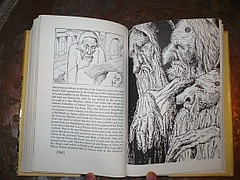
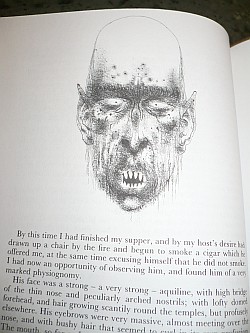
After setting down my bag, and, in cruel anticipation of things to come, procuring a two volume set of Greek tragedies for later purchase, I began the serious work of coming up with a topic for the blog. Supernatural or horror – well, certainly, but what books did we have, amenable to being weaved into a coherent narrative? It was deathly cold as I wandered the aisles looking for inspiration, and I took this to mean that our broken furnace still hadn’t been fixed. Had I known then what I do know, ah! That feeble hypothesis would have trembled at the truth, at the yet-concealed evil spirit sucking the life-force out of the very air, quivering with desire to feed on my soul. Perhaps my subconscious sensed it when I decided on the first blog book. This week’s Affordable and Interesting: a terrifying illustrated version of Dracula ($7.50).


. .
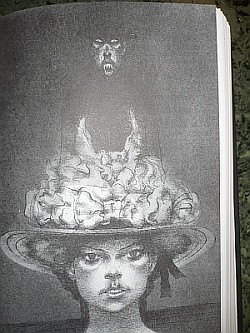


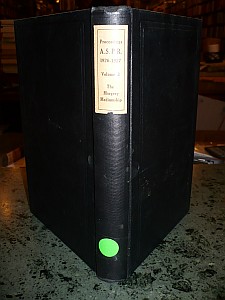
As I thumbed approvingly through its pages, pausing longer at the darkest, most evil drawings, a tremendous crash rang out behind me. I turned immediately to check on the situation at the front of the store. Though I was undeniably alone, the collection of Egyptian metal plates was scattered everywhere, and the largest piece, a bronze table-top, had landed in middle of the display window, crushing a number of books and knocking others over. This shocking discovery occupied my immediate attention for quite some time, and so it was only later, as I tried to clean things up and sort out a reasonable explanation, that I noticed the windows were completely dark. I couldn’t see outside. Even the glass in the door was dark, but I could dimly make out the shadow of the steel security gate, which had somehow been pulled shut and secured with the padlock. I called out a number of times, but no one answered. Calm down, Alan, I told myself over and over again. Just calm down, think rationally about all the evidence. But calming down was extremely difficult, especially when the books began to fall off the shelves. First two or three in philosophy, then an artbook, then something from political science in the back. Suddenly there were hundreds flying through the air, some very near my head, like horrible leather-winged bats. I received several serious paper-cuts on my face, and dropped down huddled on the floor, with my hands behind my head to protect my neck from the sharp hardback corners. Only moments later the lights snapped off, and everything went silent and still. At this point I am entirely crippled with fear, begging for mercy from some power that had obviously decided to ignore me completely. A dim light showed from the first aisle, where we keep the occult books. Like a madman compelled by some force he doesn’t understand, I moved slowly towards the glow, which seemed to be coming from behind the books themselves. Upon close inspection I realized the light was coming from the books themselves! Three, to be exact, and with a stroke of irony let me make them this week’s Collectible, though woe betide their future collector! The paper spine label reads “The Proceedings of the ASPR”.

.


I began reading a volume at random, which according to the note in the back was unavailable at any other bookstore.

Quickly I found that ASPR stands for the American Society for Psychical Research, and this particular volume concerned their research into something called the Margery Mediumship. You can imagine my horror when a high, thin voice began to wail softly, ‘Margery. Margery dear, is that you?’ I wheeled around -- nothing. ‘Now turn off the lights, Margery, there’s a good girl. You know how I don’t like the lights Margery, I really don’t like them.’ The voice sounded unhappy, and I dropped the glowing book on the floor, backing slowly away. ‘Margery. Turn it off, Margery, turn it off, off, off!!! It’s killing me Margery, do you want me to die, Margery, because I know you don’t want to die, turn it off, off, off!’ The book became blindingly bright, and I must admit that I passed out from fear. When I awoke, the books were still strewn about the store, but the lights were on. The secondary store computer was also on, though I hadn’t touched it yet, and a CD was playing old blues music. Slowly I stood up and began walking to the front of the store. After only a few steps my right foot slipped out from under me, and I fell, scraping my head badly on an old vintage typewriter behind me. At my feet was a pool of blood, far more than could possibly have come from my injury. A drop fell in the pool. Then another. I looked up, and saw a thin red stream oozing out of the heating vent.

Bang! Bang! Bang! The vent shuddered three times. ‘Mother,’ called a voice. ‘Mother, are you still there?’ The banging again. ‘Help me, please,’ said the voice. ‘Someone please help me.” And still again the banging! Numbly, I went to get one of the tall, rickety wooden ladders for accessing higher shelves. My mind was concocting all sorts of ridiculous stories: perhaps a young girl was stuck in the vent by her mother. That would explain things, I thought. She needs to be rescued. Sure, just rescue the girl, it's probably Margery. How was I to know that I was the one who needed rescuing!? I climbed the ladder, and the banging ceased. ‘Mother?’ ‘MOTHER!’ The voice went from feminine whisper to guttural snarl, and from the vent burst the cause of my eventual madness, the beast of darkness behind the blood and voices. The only way to save me from it, I fear, is by reading this week’s Favorite, the unnassuming sllsk red;las nl;aksh;ll;lk

_____________________

Sarah discovered Alan dead, slumped at the computer, when she came in for work at three. No signs of violence or struggle, and no customers in the store. Nothing had happened to the books or the window display, and the four volumes mentioned in his blog were found piled neatly on the front desk. Next to them was the padlock. There was, unfortunately, no sign of this week’s Favorite, though customers are welcome to search for it. The photos were added later, in homage to Alan’s first two selections. Happy Halloween.

Wednesday, October 8, 2008

Elect O'Gara and Wilson! We Exist!

Dear Readers,

After the slew of e-mail responses (no, really, 1 comment definitely counts as a ‘slew’) I’m changing the topic of conversation to something a little more controversial: politics. Fear not – this blog takes no sides. Or rather, I’m so amused by the ridiculous rhetoric of our candidates and this media circus of an election, that there’s really no time to take sides. Let’s start with the fact that these guys both sound like robots – boring, boring robots programmed to be as inoffensive as possible. See, there’s no real way to be sure what either candidate actually thinks – they’re both paralyzed by the desire to get elected, which restricts them to platitudes, tautologies, and catch phrases. These, of course, are decided upon by handlers, advisors, and strategists, a horde of game-players that use each candidate as a loudspeaker for their calculated nonsense.

Let’s take a great platitude: “Absolutely, I believe in America.” My goodness! Do you really? What exactly would it mean to not believe in America? America is not Bigfoot, or a fairy, last I checked. The tautologies are slightly longer, disguised by length to mask their utter meaninglessness: “Certainly, the economy falls and rises, but American workers continue working, and markets will be controlled by factors that we are responsible for. As Americans, and as people, we participate in this country, and as president I’ll work for the country, to make sure that justice is justice.” How illuminating! I was under the impression that the economy only rose, Americans were not by definition people, and the president worked for General Electric.

And don’t even get me started on the catch phrases! Holy-moly, if I hear Obama mention McCain’s statement about the “fundamentals of the economy,” or McCain bring up “earmarks,” I’m going to, well, actually, I’m going to do what we should all do. Head down to O’Gara and Wilson, where numerous books can help you free yourself from the haze that inevitably envelops all who pay attention to political discourse.

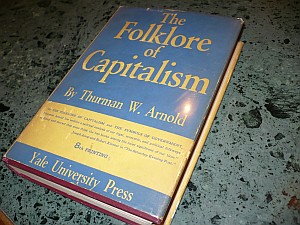
Take the economy, for example. If Nobel Prize winning economists disagree about what’s going on and how to address, why do we listen to the same tired lines from these Senators who are drastically unqualified to explain such issues? Truth is, no one really knows what’s going on. And that’s why I recommend this week’s Favorite, The Folklore of Capitalism, written by Thurman W. Arnold in 1937.


Arnold was a trust-busting lawyer who also fought for taxation by private organization. But it’s his phenomenal sense of humor and disdain for empty discourse that blows me away. Take the subheading of Chapter Three, “in which it is explained how the great sciences of law and economics and the little imaginary people (!!) who are supposed to be guided by these sciences affect the daily lives of those who make, distribute, and consume our goods.” (My italics and exclamation points of joy.) Or this eerily relevant heading on corporations: “In which is explained the doctrine of vicarious atonement through which the debts of an industrial corporation are forgiven.” Best of all, check out his analysis of the word ‘justice’: “Since justice is a nice word, we refuse to apply it to people who are struggling for things we do not like. The pacifist will refuse to admit that any war can be a war for justice. The born fighter will say that men who refuse to fight for justice do not really care for justice at all… these arguments never get anywhere in persuading the other side. However, they perform a real function in bolstering up the morale of the side on which they are used. The trick is to find a pair of polar words, in which the nice word justifies your own position and the bad word is applied to the other fellow.” Thurman W. Arnold for president, I say! Vote Arnold! $7.50 for this vintage book chosen by H.L. Mencken as one of the three best books he read in 1936.

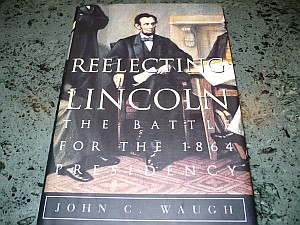
Hopefully all this has started you thinking about elections in general. Perhaps the last “wartime” election, or current candidates constant references to the war on terror have you bristling at the way politicians use fear and national turmoil to further their own political ends. Rest assured, little has changed. In this weeks Affordable and Interesting selection, John C. Waugh narrates the greatest wartime election of all in 1864.


Reelecting Lincoln: The Battle For the 1864 Presidency is filled with illuminating anecdotes and quotes. Take this effort at bipartisan dialogue: “Now that the election is over, may not all, having a common interest, re-unite in a common effort, to save our common country? For my own part I have striven, and shall strive to avoid placing any obstacle in the way. So long as I have been here I have not willingly planted a thorn in any man’s bosom…May I ask those who have not differed with me, to join with me, in this same spirit towards those who have?” Nice, Abe. You decide the proportions, dear blog reader: tautologies ( %), platitudes ( %), catch-phrases ( %). Not much has changed, it seems, except Lincoln did it all a good bit more eloquently. For a mere $4.50, you can check it out yourself.

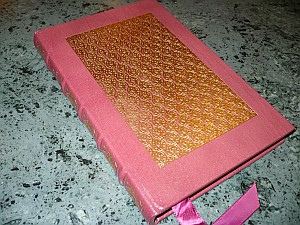
So let’s go back even further. This week’s Collectible is a leather bound Easton Press edition of The Prince, by Machiavelli.


Leather bound, silk page marker, and gilt decorations, all for $35. Let’s see what he has to say about how princes (and presidents) should conduct themselves: “Every one understands how praiseworthy it is in a Prince to keep faith, and to live uprightly and not craftily. Nevertheless, we see from what has taken place in our own days that Princes who have set little store by their word, but have known how to overreach men by their cunning, have accomplished great things, and in the end got the better of those who trusted to honest dealing. Be it known, then, that there are two ways of contending, one in accordance with the laws, the other by force; the first of which is proper to men, the second to beasts. But since the first method is often ineffectual, it becomes necessary to resort to the second.”

Looks like politicians may have been doing their reading after all. From O’Gara and Wilson, this is Alan, over and out.

Thursday, September 25, 2008

The Survival of Used Bookstores, A Digression

Dear Readers,

Many of you have been to our store before. No doubt you are acquainted with the monk who sits serenely at the rear, and the ill-fated buffalo whose head hangs just above the beginning of American History (no coincidence, that). What, one might ask, do these two members of O'Gara and Wilson have in common with Douglas Wilson, owner of this venerable institution? What spiritual kinship inspired him to recruit such unusual allies in the bookselling battle?

Let me put your curiosity to rest. The Scriptorium monk represents care for the printed page, a connection with times long past, when an author's text required the hand of a craftsman for its completion. In the mid-1800's book-binding machines began to catch on, slowly reducing the concept of "book" to nothing more than an efficient means for distributing ideas. Mr. Wilson and Jerome, as he is fondly called, still cherish the idea of book as artifact, something the significance of which depends not merely on the meaning of the words within, but is continually shaped by all those who share in its history, from the author to the customers that frequent second hand bookshops.

And the buffalo? Both he and Mr. Wilson represent what biologists refer to as a “keystone species.” A keystone species has a disproportionately important effect on its surroundings. Though its presence may be small in terms of population, the existence of a keystone species is crucial for sustaining diversity of life in its environment. When such a species goes extinct, the ecosystem that it supports falls apart, like a bridge whose keystone has been removed. Mr. Wilson and the store he runs are a powerful if subtle force, shaping the Hyde Park community and consequently the world. Luminaries like author Saul Bellow and theologian David Tracy have found fuel for their intellectual furnaces here, at this well-stocked woodpile of ideas, whose logs are daily gathered, bundled, and delivered by the bibliotaph (one who caches or hoards books) of whom we speak. Not to mention the many others who pass through our doors, hoping to stumble upon some synchronicity that radically changes their perspective. One can only imagine what would happen to the diversity of life and thought in Hyde Park if O’Gara and Wilson were to be replaced by, say, another Borders.

And that brings me to the most important part of this blog, namely the crucial difference between Mr. Wilson and these two fixtures of his bookstore. Not only is he still alive, but Mr. Wilson plans on continuing to thrive. He will not bow to the cultural forces that escorted monastic scribes and majestic herds to their respective graves. This keystone species, at least, is fighting and winning. The used bookstore’s struggle to survive can take many forms. Mr. Wilson is unique in that he employs a three-pronged approach. In fact, he himself has suggested the metaphor of a three-legged stool. This term was supposedly coined by Oxford scholar Rev. Richard Hooker, in reference to the Anglican church (sorry, Jerome) and the three legs that support it: scripture, reason, and tradition. Our elements are humbler, but no less important to stability. They are high-end auctions (Collectible), in-store sales (Favorite), and the internet (Affordable and Interesting).

Most people don’t know it, but much of the bookstore’s revenue comes from consigning very collectible books and items to auction houses. These venues have an international audience, ranging from university libraries to enormously wealthy private collectors. Here are some examples:

http://www.swanngalleries.com/index.cgi

http://www.bonhams.com/

While your average walk-in customer may not have the necessary liquidity to purchase Shakespeare’s hand-written first draft of Romeo and Juliet (originally entitled Romeo and Bernice, it appears), auction houses allow Mr. Wilson to distribute such items through the proper channels.

But whence these auction-worthy artifacts? Is Mr. Wilson some sort of latter-day treasure hunter, digging under every Hyde Park oak until he discovers the secret stash of an eccentric Shakespeare scholar? Do kind souls simply drop box upon box of their Loeb classics on our doorstep? Nuh-uh. Aquiring a truly magical used bookstore inventory is a simple function of customer relations and rapport with fate.

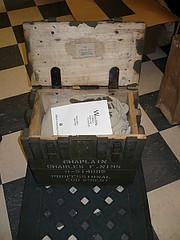
Let me explain. Quite often it is long-time bookstore patrons who provide us with our wares. We have seen books come back through that were once sold by Mr. O’Gara over thirty years ago. Without long-term customer relationships our store would be dead in the water, not only because no one would sell us any books, but also because many people wouldn’t have cool books to sell. Just as often, though, sheer chance seems to bless Mr. Wilson with extraordinary caches of books and objects, although when something chancy occurs on a regular basis it’s usually due to something. But how do you explain this –


.


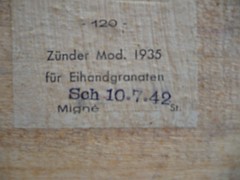
a German hand-grenade storage box, converted by an army chaplain into a container for bibles and altar cloths. Talk about swords to plowshares – and a serious instance of the book as a historical artifact. Good luck finding another one of those, or any of the other strange confluences of events that can be found and purchased at O'Gara and Wilson…
Unfortunately, the gusts of modernity will overturn any two-legged stool. Science and technology vigorously trumpet the demise of feeble furniture: “Physically impossible!” they cry, or “I can buy a three-legged stool for less online!” until the vast majority of two-legged-stool-used-bookstore-hybrids are chopped into metaphorical kindling, to be sold somewhere else, or failing that, to be unceremoniously dumped in the dustbin of history. We have not remained in the Luddite past of unscientific bookstore cavern-people. Like some nuclear accident that results in a positive mutation, we evolved a third leg. The internet.

http://www.abebooks.com/servlet/ListingBrowse?vendorclientid=78077

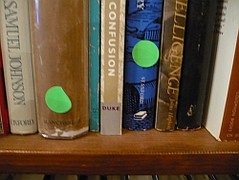
That links to our online inventory. You may have thought the appearance of these funny stickers around the store had a deep meaning –


-- discounts, perhaps, or a pox with a tendency to infect more expensive academic texts. Not so. These are the brands of the internet, bright marks of our submission to a new order. Orange dot: book might go online. Green dot: book is online. Some days we sell more books online than we do in the store. Much clerk time goes into putting books online, or searching the internet for prices so we can be the best deal in town (that is generally how we price our books, in line with the lowest online prices). There is a new competitive force; the open market of the internet has changed the face of bookselling. Now a beautiful art book might be worthless because so many were printed, but an expensive Russian calculus book might be salable to a client overseas. There are drawbacks to the internet, but for a store like ours there are also advantages, provided we are ready to use them. Right now, in fact, you are helping us with another aspect of the mutant technological third leg, just by reading this blog. Go on, write in! Let us know you made it this far through the blog! Let us know you’re out there! Come into the store, and say – the blog technology brought me here!

Uh-oh. Things are getting a little out of hand. I think we covered everything we set out to cover – from O’Gara and Wilson, this is cyber-Alan, wishing you a three-legged future with Jerome.

Wednesday, September 17, 2008

To picture or not to picture...

Dear Readers,

The focus of our current blog is a topic close to my heart – the illustrated book. There is no question, of course, that certain types of books benefit from illustrations. One shudders at the thought of a cookbook entirely bereft of pictures, and an art-book without some reproductions of the works it treats seems, at least to me, entirely pointless. But the relative value of illustrating fiction is not so easily decided. Tolkien himself, in his essay “On Fairy-Stories” complains that illustrating such tales deprives children of the opportunity to imagine things for themselves. This, of course, from an author who illustrated the Hobbit himself. While Tolkien doesn’t count the Hobbit as a fairy-story, it seems plausible to extend his argument to all illustrated fiction. Somehow, the act of reading is essentially an imaginative one, and illustrations restrict the reader’s freedom, imposing particular images onto the blank canvas of the text.

I’ve heard people make similar claims about movies – Christopher Tolkien wanted nothing to do with the film adaptations of the Lord of the Rings, saying they were peculiarly unsuited to film, and his father has been quoted as hating all things Hollywood. After watching the cinematic form decimate favorites like The Phantom Tollbooth and The Hitchhiker’s Guide to the Galaxy, some might be inclined to agree. But the issue is more complicated than that. Certain books might be bad material for film adaptation. Others, like Gone with the Wind, Pride and Prejudice, and One Flew Over the Cuckoo’s Nest, do quite well, in my opinion. There is, I think, no standard rule to be applied in this case. Plays, needless to say, are actually meant to be performed – with Shakespeare or Beckett we should have no compunctions about restricting the reader’s imagination with a movie or performance, since the reader is actually meant to be a spectator. A book that has been singled out as impossible for adaptation (Sterne’s Tristram Shandy, for instance), is simply waiting for a talented film-maker to rebut the claim.

So when should something be illustrated, and when should things be left to the reader’s imagination? Do the same rules apply – can a good illustrator always rebut the claim that a book ought not be illustrated? Perhaps. But maybe a different place to start is the general consensus on which audience benefits most from illustrated books. The answer is easy: children. Modern novels tend not to be illustrated – children’s books almost always are. Indeed, the amount of illustration in a book is inversely proportional to the target age group. (Imagine Dr. Seuss without illustrations!!)

At first this trend might appear intuitive. Kids like pictures. They need them to supplement necessarily sparse narratives, and peak their curiosity. Or do they? “When we are very young children we do not need fairy tales: we only need tales. Mere life is interesting enough. A child of seven is excited by being told that Tommy opened a door and saw a dragon. But a child of three is excited by being told that Tommy opened a door. In fact, a baby is about the only person, I should think, to whom a modern realistic novel could be read without boring him.” G.K. Chesterton makes a wonderful point. Children have vibrant imaginations, lacking in most adults, it seems. Not only that, but our modern attention span has dwindled to a pathetic shell of itself – just look at the length of camera shots in recent movies compared with those of a couple decades past. One could make the case that it is adults who need illustrations to help them imagine things more vividly, especially given the rather dry content and increasing length of the reading material they tend to choose.

You may, at this point, be starting to lose patience. It is my hope, in fact, that you are thinking, “All right, all right, enough already. Where are the pictures of the books? That’s why I read this blog.” Because if you are, it would make my argument that much more compelling. The interest of this blog lies in part with the inclusion of pictures, which spruce up the otherwise dreary procession of letters that currently clog your screen. So without anymore boring, intellectual, adult-oriented prose, I offer three books for your consideration. All are illustrated, and they cover a wide enough variety of target audiences for any interested blog readers to come in and settle this question for themselves.

Collectible


.
.


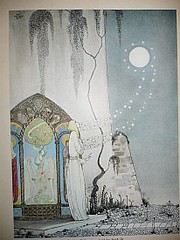
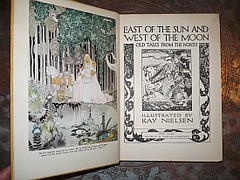
Book: East of the Sun West of the Moon. $200. Target audience: Children (and wealthy adults). Illustrator: Kay Nielsen. One of three greats from the golden age of book design and illustration (Arthur Rackham and Edmund Dulac are the other two). He is my favorite of the three, due to his pronounced Asian influence and particular skill with line drawings. This book of Norse fairy tales showcases, I think, his best work. Absolutely wonderful example of the lavish gift books produced during the first half of the 20th century.

Favorite


.


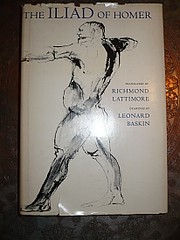
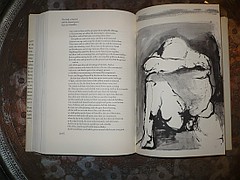
Book: The Iliad. $30.00. Target audience: Adults (and unusually precocious children). Illustrator: Leonard Baskin. Baskin was close to Ted Hughes and Sylvia Plath, among other luminary literary figures. He sculpts and illustrates, and his influence can be seen in modern illustrators like Ralph Steadman. Particularly good at portraits, Baskin’s interpretations are often dark and disturbing. I absolutely love this guy – and I’ll be honest, I need his help to get through Homer. Among Baskin’s greatest works is an edition of Swift’s “A Modest Proposal,” which leads nicely into the final item.


Affordable and Interesting


.


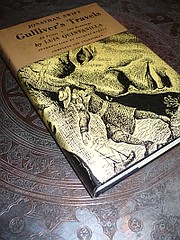
Book: Gulliver’s Travels. $7.50. Target audience: Adults? Children? Illustrator: Luis Quintanilla. Manifestly a book for adults, the fantastical elements of Swift’s “frank and vitriolic satire” (from the dust jacket) are now popularly targeted at children (in abridged editions, a topic for another blog…). Almost every page of this edition is profusely illustrated with Quintanilla’s hilarious black and white prints. A stunning example of graphic art, at a remarkably affordable price.

There you have them. Say whatever you like about the relative merits of book illustration, but make sure your opinion is educated, preferably through a visit to our store.

From O’Gara and Wilson, this is Alan, over and out.

Wednesday, September 10, 2008

Dear Readers,

Part 1: Collectible

“The history of mankind, as a history of the human spirit, may be thought of as consisting of two elements: an escape from this world to another; and a return to it. Chronologically speaking, these two movements, the rise and fall, represent the whole of human history; and the two take place microcosmically many times in peoples and nations…

The nature of haiku cannot be rightly understood until it is realized that they imply a revolution of our everyday life and ways of thinking.

…Haiku record what Wordsworth calls those ‘spots of time,’ those moments which for some quire mysterious reason have a peculiar significance. There is a unique quality about the poet’s state of feeling on these occasions; it may be very deep, it may be rather shallow, but there is a ‘something’ about the external things, a ‘something’ about the inner mind which is unmistakable. Where haiku poets excel all others is in recognizing this ‘something’ in the most unlikely places and at the most unexpected times.”

-- R.H. Blyth (selections from the prefaces)


Flying in by the bamboo-blind,

The swallow is tame

With the beautiful girl.

-- Ransetsu


The kingfisher;

In the clear water of the pond,

Fishes are deep.


--Shiki


In the spring breeze

The snowy heron flies white

Among the pine-trees.

--Basho


.


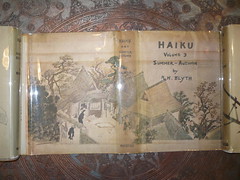
Haiku, 4 volume set of first printings, $200.


Part 2: Favorite

I

Among twenty snowy mountains,

The only moving thing

Was the eye of the blackbird.

II

I was of three minds,

Like a tree

In which there are three blackbirds.

III

The blackbird whirled in the autumn winds.

It was a small part of the pantomime.

IV

A man and a woman

Are one.

A man and a woman and a blackbird

Are one.

V

I do not know which to prefer,

The beauty of inflections

Or the beauty of innuendoes,

The blackbird whistling

Or just after.

VI

Icicles filled the long window

With barbaric glass.

The shadow of the blackbird

Crossed it, to and fro.

The mood

Traced in the shadow

An indecipherable cause.

VII

O thin men of Haddam,

Why do you imagine golden birds?

Do you not see how the blackbird

Walks around the feet

Of the women about you?

VIII

I know noble accents

And lucid, inescapable rhythms;

But I know, too,

That the blackbird is involved

In what I know.

IX

When the blackbird flew out of sight,

It marked the edge

Of one of many circles.

X

At the sight of blackbirds

Flying in a green light,

Even the bawds of euphony

Would cry out sharply.

XI

He rode over Connecticut

In a glass coach.

Once, a fear pierced him,

In that he mistook

The shadow of his equipage

For blackbirds.

XII

The river is moving.

The blackbird must be flying.

XIII

It was evening all afternoon.

It was snowing

And it was going to snow.

The blackbird sat

In the cedar-limbs.

--Wallace Stevens


.


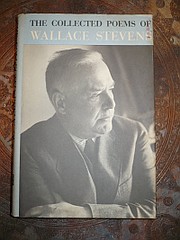
The Collected Poems of Wallace Stevens, 1982 printing, $7.50


Part 3: Affordable and Interesting


Sections on rhythm, and rhyme, and the music of words. Each poem with a sentence to inspire thought about poetic technique.

The Poet’s Craft: Selected Verses, Daringer and Eaton 1935, $10.50