Wednesday, March 18, 2009

Homage to the Kindle. Not.

It was March 18, 2109, and I was bored. Quendy and I were lying next to each other on Quagnar beach, drinking Zoofle Blasters and watching sky pirates shooting each other down over the ocean.

“I’m sick of Zoofle Blasters,” I said, throwing away my fluorescent blue cup. It disappeared as soon as it hit the sand. “And I’m sick of sky pirates. They always do the same thing every time.”

“Me, too,” said Quendy. “Maybe we should go visit the Xenon 5 beach. They have a whole new sky pirate show.”

“Okay,” I said. We both felt 25 zilodollars drain from our accounts, and the beach around us changed. Now it was green sand, instead of black. The sky pirates were black, instead of red, and they shot each other down even more frequently. There were four suns in the sky.

“What kind of drinks are there here?” I asked.

“I don’t know,” said Quendy. Immediately a pull down menu appeared in our heads.

“I’ve had all of these,” I said.

“Me too,” said Quendy.

“Well,” I said, “maybe we should call it a day. I can’t think of a single thing to do.” We lay there in the green sand, not wanting to go somewhere else because we’d already spent 25 zilodollars getting to Xenon 5. Suddenly Quendy spoke up.

“I have an idea,” she said excitedly. “I know something we could do. Let’s go to a bookstore.”

“A bookstore?” I asked. “Why?” I’d already downloaded all the books I needed for school. I had them on background filter, and they were slowly transferring directly into my brain. Some people like to do it all in one go, but that makes my head hurt.

“No,” said Quendy. “This is different. I saw it when we went to visit Grandma and Grandma in Happy-Old Land.”

“Oh,” I said. “So it’s out there?”

“Yeah,” said Quendy.

“Weird,” I said. “Why would there be a bookstore out there?”

“You’ll see,” said Quendy. We turned off our Virtua-Screens, and got up from my sofa. Then we got in the hyper-car, and Quendy set it for 5212324 Happy-Old Land Drive.

“I know it’s near there,” said Quendy. When we appeared, things looked pretty familiar. I’d only been to 3423435 Happy-Old Land Drive, to visit my grandparents, but this place wasn’t so different.

“I think it’s next door,” said Quendy. “But we have to walk.” We got out of the car, and walked about twenty feet to the next building, which felt strange. The building said “O’Gara and Wilson” on an green cloth thing hanging out in front.

“This is it,” said Quendy. “I’ve been here with my grandmother once.”

Inside the store were all sorts of things that I’d learned about in history class, called realbooks. There were big realbooks, and little realbooks, and they were filled with words, just like the ones in the advertisements and pull-down menus.

“This is so weird,” I said. “What do you do with these?”

“Read them,” said a voice behind me. “Although no one really does, anymore.” I turned and saw an ancient man, with bushy eyebrows and a goatee.

“Why would you read them,” I asked, “if you can just download them instantly and transfer them into your brain in the background?”

“Well,” said the old man, “some realbooks aren’t actually available for download. Take this one, for example.”

He opened a case made out of something called glass, and took out one of the strange old things. The front (he called it a cover) looked like this.


“Careful,” he said, as I flipped through it.

“Cool,” said Quendy.

“Not just cool, young lady,” said the old man. “It’s the coolest Collectible realbook in the store. Written in 1901 by H.G. Wells, a first edition, back when people had never visited the moon before.”

I’d been to the moon with Quendy lots of times. Super boring, unless you’re a little kid. “Can’t download a first edition,” added the old man, though I didn’t know what he meant. “That’s why it’s so expensive.” 400 zilodollars, said the price tag. That was like 16 beach trips.

“What are these?” asked Quendy, who had found something somewhere else in the store.


“That’s a magazine,” said the old man. I recognized the little white cylinders in the picture – they were cigarettes. Long ago, said the history textbook I’d uploaded last year, people used to kill themselves by smoking them.

“Is a magazine a realbook?” I asked.

“Not exactly,” said the old man. “But it would take too long for me to explain the difference. Not too expensive, though,” he said. “Only 6 zilodollars, so you could probably get one yourself. We’ve got Time magazines, like that one, and also Life magazines. Affordable and Interesting, magazines.”

“Of course,” he said, “you probably don’t know how to read.”

“Nope,” I said. Only old people knew how to read, like this guy or grandparents. “It would take so long. And these realbooks are big and clunky. I think downloading is much easier.”

“I don’t know,” said Quendy. “Maybe it would be fun to learn how to read.” The old man didn’t say anything. He just went over and pulled another realbook off the shelf and started reading from the back.


This is what he read:

“We read to find the end, for the story’s sake. We read not to reach it, for the sake of the reading itself. We read searchingly, like trackers, oblivious of our surroundings. We read distractedly, skipping pages….We read in gusts of sudden pleasure, without knowing what brought the pleasure along.”

Quendy and I browsed for a while, and I ended up buying the realbook the old man had read from, for only 9.5 zilodollars. It was called A History of Reading, by an elder-one named Alberto Manguel. Even though it didn’t look that special, it was my Favorite thing in the store, and no matter how much I searched the Virtua-Center, I couldn’t find a copy available for download, at least not at that price.


(Thank you to M.T. Anderson and his wonderful realbook, "Feed".)

Wednesday, March 4, 2009

"All for me Grog-Blog"

(Apologies to multimedia fans out there -- no pictures this time, technical difficulties).

______________________

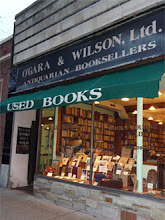
Close readers of this blog may have noticed that the name of our store is O’Gara and Wilson. Wilson, needless to say, is the surname of our current visionary owner, Douglas Wilson. But what of “O’Gara”? Who’s behind those beautiful Irish syllables?

Don’t worry, I’ll give it to you quick and easy. Joseph O’Gara, a bookman of the highest order, that’s who. He inherited the store in 1937, and ran it for a long, long time. Smoked a pipe, had a cat, and argued with anyone and everyone who walked through the door. He left us for the Heavenly four-leafed clover meadows some years back, but his spirit still lingers in the bookshelves and the treasures they hold.

In fact, his spirit was in here this morning. “Alan,” it said wispily, but with a pronounced Irish brogue. “Why haven’t you gotten started on the grog?”

“Who’s there?” I asked. “What ghost haunts this bookshop? And what kind of grog does it fancy?” I added, just in case.

“Not grog,” said the spirit, materializing slowly. It was bald with a moustache and wire-rimmed glasses, and a pipe in its mouth. “Blog. Young Dougie has hired a real winner here, I see.” That’s when I knew it must be him, the legendary Joseph O’Gara.

Now, those who knew Mr. O’Gara might object at this point, if they haven’t already. “He didn’t speak with an Irish accent,” they might say, or “He never referred to Mr. Wilson as Dougie.” Fair enough. If you want the scoop on our founder, come in and chat with Mr. Wilson himself. He’ll tell you how Mr. O’Gara faked being Scottish, regaled customers with crazy tales, and made the bookshop a wonderful place to be.

But for the sake of this blog entry, please let’s power through the falsehoods until the imminent segue.

“I haven’t gotten started because I’ve got writer’s block,” I told Mr. O’Gara’s spirit. “I’m completely stumped.”
“Well, lad, write on Ireland, my homeland.”
“But why Ireland?”
“What’s wrong with you?” he said. “Are your brains addled from not enough reading? It’s Irish-American Heritage month!”
“Good Guinness!” I shouted. “That’s brilliant! But there’s a problem…”
“What’s that?” asked the spirit, and ultra-wispy smoke wafted from the semi-wispy pipe he held clamped in his teeth.
“Well—“ I hesitated.
“Out with it, lad!”
“I don’t know anything about Ireland. Not a single thing.”

Mr. O’Gara flitted over to the Ireland section.

“Start with this,” he said, and handed me the ironically titled Oxford Companion to Irish History.

“Leaping leprechauns!” I exclaimed, after flipping through it briefly. “It’s so informative and thick, just like all the other companions from Oxford that we've come to know and love. And cheap too, only $9.50! I’ll make it our Affordable and Interesting item.”

“Enough with the shop-talk,” said Mr. O’Gara. “You’ve not much time before I disappear and your deadline comes.”

“But I’m helpless without you,” I said. “All I know about is Chinese philosophy and fairy tales.”

The spirit’s moustache twitched with impatience. “And didn’t Oscar Wilde write about both?”

“Sure,” I said, “but that doesn’t help.” Suddenly it hit me like a blood pudding in the face. “He was IRISH,” I exclaimed, and rushed to the glass case and picked out one of most wonderful Collectible books in the store.

Were the blasted camera working, you'd be treated to numerous pictures from the second edition of Wilde’s famous fairy tales, illustrated by Walter Crane and Jacob Hood. You would be able to see the beautiful condition, and establish for yourself that the price of $650 is easily worth it. This book, you would think to yourself, is something one finds at the end of a rainbow on a lucky day. Instead you'll have to imagine all that, or come in to our store and see it in person.

In fact, the book is so wonderful that I began paging through it myself, before the blog deadline interrupted my reveries.

“Aiee!” I said, looking through Mr. O’Gara at the clock. “It’s nearly time, I’ve got to post this thing.” With a disdainful nod, the spirit floated back over to the Ireland section.

“This is probably beyond you, lad, but put it in there. Only true Irish-people will know what it is. But it’s one of my Favorites, from when I was a wee boy.”

He handed me (how did he do it with those wispy fingers) a book that appeared to be in a foreign language.

"But I need something in English," I said. Mr. O'Gara didn't even deign to answer. I asked the computer and found out that Fiche Blian Ag Fas translates as Twenty Years A’Growin, and it’s one of the most famous pieces of modern literature written wholly in Irish. An excellent present for the Irish lover in your life, difficult to find in a nice vintage edition like ours, and impossible for a mere $15.

As soon as I finished writing that last paragraph, Mr. O’Gara tapped out his pipe and spoke his final words to me.

“The craic was good,” said the spirit, and disappeared.

That’s right – it’s pronounced crack. But don’t go getting any ideas until you read up on the original meaning, hopefully in a book you purchase from O’Gara and Wilson. And "All for me Grog" really is a real song (just ask the Google-mind if you're an unbeliever).

Happy Irish-American heritage month!

Wednesday, February 18, 2009

How to manage your miffed Valentine: a lesson, with O'Gara and Wilson

Since we only update the blog once every two weeks now, I totally missed Valentine's Day. Did you also miss Valentine's Day? If so, then this is the blog entry for you! You will learn all about some gifts you can give your lover to make up for your unbearable faux pas. What expresses love better than crass materialism? I ask you.

Let's start with this week's Collector's Item: great for the man in your life, assuming the year is 1926 and your man really likes Benjamin Franklin.


Let us begin with a Valentine-relevant quotation from a "Beau Magazine" watch advertisement:

Choosing your woman (to employ the phrase of our national arch-beau, Benjamin Franklin) is only the beginning of your adventure: to hold her (if hold her you must) you must have become skilled in that most delicate of all the social arts -- the art of selecting the proper gift for the proper occasion.

Now the "Beau" is an inveterate believer in this pleasant form of bribery. Gift giving is the oil of the social machinery, the only form of flattery which women have not yet learned to suspect, and therefore to be pursued with a certain amount of assured success.


Well, I've certainly learned to suspect it now. So maybe you shouldn't buy this book for your lover ... maybe, instead, you should buy it and hide it from them such that they never learn its secrets.

You will also be concealing many other delights: for instance, a reprinted letter (purportedly from 1745) from Benjamin Franklin to a friend on "Choosing Your Woman". Franklin urges his friend to select an older woman for a mistress for eight reasons, one of which starts with "Because when they cease to be handsome, they study to be good." Do we really? These and other pieces of advice come to $75.00 -- discuss 1926 romantic mores with your lover (or alternatively, hide these insights from your lover) to your heart's content.

Perhaps you and your partner pen a lot of love letters? In that case, you can use this week's Favorite to write a historically accurate one, World War 2-style:


V-mail (short for "Victory mail") was a form used entirely by soldiers on the front during World War 2. They would write in special ink ...


(here we have two facets of the ink box ...)


... on special forms ...


... and their letters would be applied from paper form, to microfilm. The original forms would then be destroyed and big bags of microfilm sent overseas, to be reconstituted into letters for mopey loved ones. As noted by the National Postal Museum: "The 37 mail bags required to carry 150,000 one-page letters could be replaced by a single mail sack. The weight of that same amount of mail was reduced dramatically from 2,575 pounds to a mere 45."

I am sure that a military history buff would find a love letter written V-mail style to be the most romantic thing ever. Indulge them: a box of forms and a box of special V-mail ink -- Quink! -- is only $25.00 and provides dozens of letters!

(And before we move on to the next items, a quick message from Doug: "Before there was e-mail, there was v-mail!" Hilarious.)

Last but not least, gentle readers: an Affordable and Interesting way to relate to your loved one.


You may have heard of the Kama Sutra, an ancient Indian text on physical love. Well, I am here to tell you that there are many, many editions of the Kama Sutra out there, and we've got a bunch of them here at O'Gara and Wilson. The one presented above takes what I think of as the "academic and cultural approach" -- tasteful cover featuring a pretty Indian painting, restrained script, all promoting the scholarly value of this tome, and all for $15.00!

Then there's this approach!


This I consider the "scandal" approach. Published in 1963, it emphasizes the mind-blowing debauchery therein. The photo of Greek statuary totally fails to respect the original Kama Sutra's cultural context. Yours for $7.50.

And here's the third and last in my "Kama Sutra marketing through the ages" series:


Not cultural, not academic, but not scandalous either: this one's all about long walks on the beach, soft-lit candles and romantic dinners. $12.50.

That should pacify your partner, gentle readers! Don't say I never do you any favors ... and oh yeah, happy belated Valentine's Day!

Wednesday, February 4, 2009

Black History Month 2009 is upon us! Also, Soviets.

February, my gentle gentle readers, is upon us in all its snow-laden glory. On the bright side, February is Black History Month! Most of this blog entry shall regale you with many amazing items of African-American historical value ... but not all of it. Why, you ask? Well, because this week's Affordable and Interesting item was supposed to be picked up by Doug when he went home to Indiana for the evening ... but then, a stunning amount of Indiana snowfall kept him in Chicago for the night.

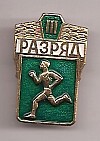
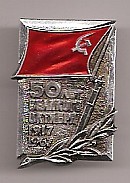
So, before we continue on to Black history, dear readers, allow me to show you these Affordable and Interesting pins:

. .

.


.

. .


The above pins were produced in the former Soviet Union between the late 1960s and the early 1990s -- they were badges for all manner of occupations, clubs, and organizations. Our regular Jon characterizes them as "bright, sprightly, and lots of fun" and reports that he gave one to his friend Olga, who translated its slogan as "Society to Fight for Sobriety". When she picked herself up from rolling around of the floor laughing, she added, "I need some more for my friends."

These pins are a bargain at $3.00 apiece; I'd consider buying the Stalin one myself, but I want to be able to take airplane flights.

Now let's move on, away from my hasty insertion of those pins and towards this week's Favorite:


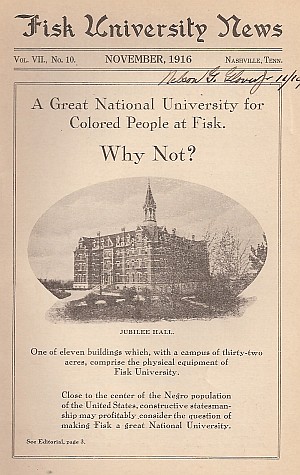
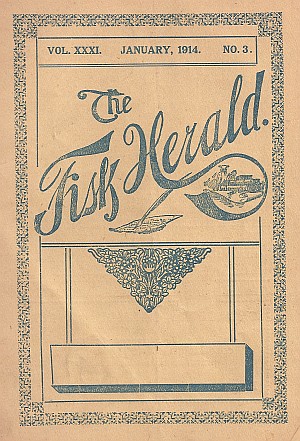
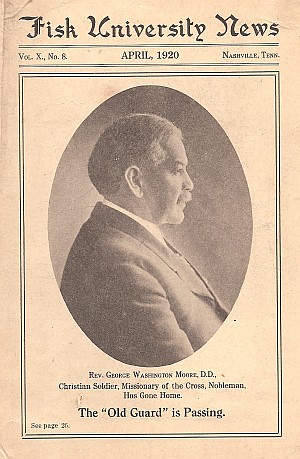
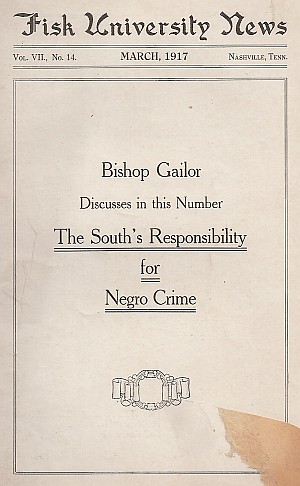
Fisk University was one of the first African-American Universities -- established in 1867. It is now open to all races, but has historically served Black history very well -- one notable instance being the Fisk Jubilee Singers. The Singers started touring in 1871, and they did a lot to preserve African-American musical traditions and further the acceptance of those traditions in popular culture.

We have a number of 1910s-1920s Fisk University magazines here at the shop, showcasing various interesting historical angles:


.


.


The Fisk magazines vary in price from $20.00 to $25.00 -- or act now and you might be able to snag the 1916 Fisk Alumni Quarterly for only $10.00!

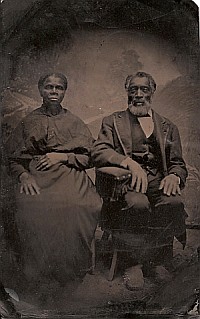
Last, but certainly not least, we arrive at this Collector's Item, which includes an amazing and touching story:


This, ladies and gentlemen, is a real live tintype of Mr. and Mrs. Watham, who were once enslaved in the southern United States. In the second half of the 1800s, the Wathams were freed, and they struck off to make their fortunes by participating enthusiastically in the Oklahoma Land Rush. These two Black pioneers established an Oklahoma homestead that served their families well until their descendants sold it off in the 1950s, at which point one trunk full of the Watham's heritage was saved.

That trunkful of history is now here, at O'Gara and Wilson! Its contents include -- but are not limited to -- two cotton bonnets, a blue polka-dotted parasol, a spyglass, two leather baby booties, a corncob pipe, a thimble, and two six-sided dice. We're selling this collection for $750.00, and we encourage all and sundry to come by and examine it before someone takes it home. All these objects come together to create a lovely picure of the lives of two pioneers of the American West. They're really fun to look through!

Black History Month seems like a particularly inspiring time right now, with our first Black president assuming power. (I know I've been mentioning that a lot lately, but cut me some slack, gentle readers -- I live in Obama's very neighborhood!) Let that inspiration warm you against the frigid February weather.

Wednesday, January 21, 2009

Alan refers to us as an "increasingly inaccurately named bookstore"

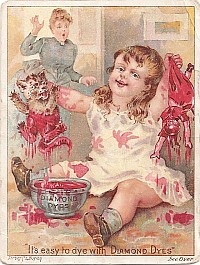
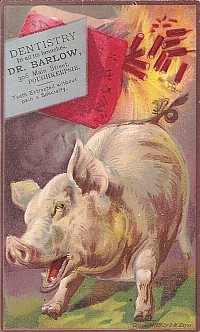
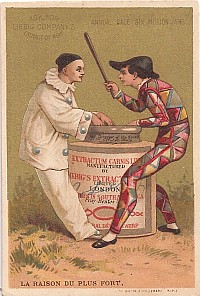
Sometimes we joke around the store about how we barely even sell books here -- we are so inundated by other amazing historical material. One great example are these fabulous, semi-insane Affordable and Interesting Victorian marketing cards. I had a really hard time choosing just six of them to show you, gentle readers -- we've got a whole boxful! Fortunately (or perhaps un), a recent customer already bought up all the ones that featured little children dressed up as insects and snails.


.


.


.


.


.


I can't even begin to imagine what the Victorians were thinking when they decided to use some of these images to advertise their businesses. I mean, I'll accept that quasi-demonic children drowning cats in ink is a fabulous promotion for dye! But what does a pig frightened by firecrackers have to do with dentistry? And do you realize that those two clowns are eyeing each other over a pot full of "meat extract"? These cards are $3.00 apiece, which I consider a low price to pay for the opportunity to raise our eyebrows yet again at those crazy Victorians.

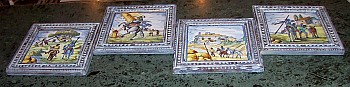
For this week's Collector's Item, let's move on to something saner, like Don Quixote:


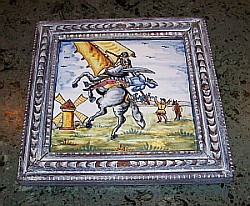
We've got a set of four beautiful porcelain tiles showing Don Quixote at his best! My personal favorite is this one, with a windmill ....


I find that frequently, the phrases I use require extensive explanation (for instance, I recently really confused some friends by saying, "Don't look a gift horse in the mouth"). I mention this because there is a wonderful phrase -- "tilting at windmills" -- that means "attacking imaginary enemies". It derives from the Quixote scene above, and even if you have not read the book you can probably figure out what happens in that scene. Ah, Quixote ... you taught us farce. Celebrate Don Quixote with these tiles: $150.00!

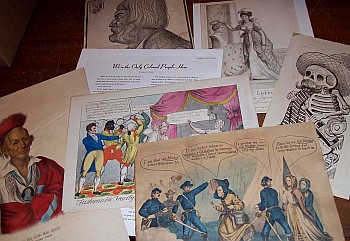
Our last non-book objects for today feature one of Doug's Favorite pieces of racial commentary:


We've just gotten in a number of amazing prints, now hanging all about the store in various positions! Doug is particularly in love with a large, broadside-style printing of Gwendolyn Brooks' "We're The Only Colored People Here". Brooks, a Chicagoan through and through, was a well-known African-American poet whose works gained international fame. This piece is an especially touching bit about the way the world was as it was desegregating, and yet its inhabitants were still a bit uncomfortable when they mixed. In the 1930s, Paris-based Black Sun Press issued a series of large poster-type printings of very short fiction -- including a very nice 12" x 15" version of "We're The Only Colored People Here".

The Gwendolyn Brooks is $40.00. The rest of these prints vary in price from $35.00 for a lovely engraving of Marie Louise looking benevolently cross-eyed, to $300.00 for the below print:


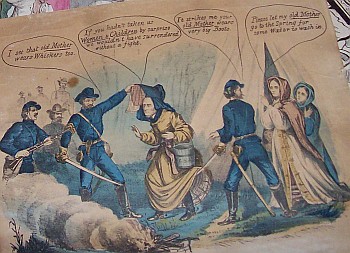
Apparently -- at the end of the Civil War -- Jefferson Davis mistakenly threw on his wife's raincoat as they were trying to flee capture by Union soldiers; when caught, he was widely mocked for supposedly "dressing as a woman" in an attempt to escape. Above is just one of the political cartoons that resulted!

I'm inspired by those Victorian cards -- I think I'll go home and find some cats to dye! Never claim that the media doesn't affect your children, gentle readers.

Saturday, January 17, 2009

Let's put this inauguration in its historical context!

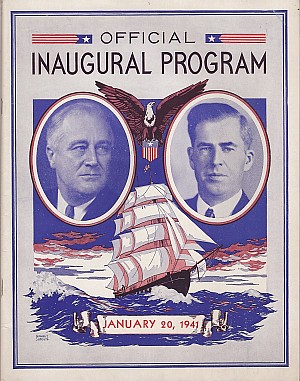
Here we have a special edition of the O'Gara and Wilson Store Blog! In honor of Barack Obama's inauguration, we are featuring a collection of items from two previous historical inaugurations -- those in 1941 and 1945, for Franklin Delano Roosevelt. (His first vice president was Henry A. Wallace; his second, Harry Truman.)

We have all kind of materials here, from invitations to inauguration tickets to programs, etc. etc. etc. ....


Here's the 1941 official program for you ....


... and the list of ceremonies, complete with adorable tri-color ribbon!


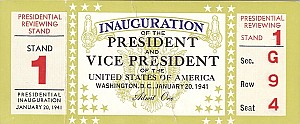
If you'd attended in 1941, you would have presented this ticket.


There's the back of the ticket.


And if you were lucky, you'd have been invited back in 1945!

There are other things included in this little group, too -- all told, there are nine (count them, 9) pieces of Roosevelt inauguration ephemera. Celebrate inaugural history by purchasing this great collection for $250.00!

Here ends O'Gara and Wilson Special Bulletin for today! I have to venture outside now, but at least it's a whole 20 degrees or so.

Wednesday, January 7, 2009

Barack Obama, we hardly knew ye!

Ah, gentle readers ... the travails of living in Barack Obama's neighborhood! Occasionally I must display legal identification to the police in order to reach my home; the excellent local restaurant Medici now requires all its wait staff to wear shirts that say, "Obama eats here". Let's hope Obama rises above the record set by previous Chicago politicians such as Rod Blagojevich. (What's your favorite Blagojevich quote? Mine is, In a Nov. 11 conversation, Blagojevich acknowledged that Obama wanted an unnamed "Senate Candidate 1" for the seat but "they're not willing to give me anything but appreciation. [Expletive] them.")

This week we learn that Blagojevich is in a fine, established legacy of evil. For instance, let's look at this Affordable and Interesting item:


.


This little book-shaped matchbox-holder was used to promote P.J. Carr in his 1926 campaign for Sheriff. "If elected Sheriff," the matchbox-holder promises, "I will make all of the highways of Cook County absolutely safe for every man, woman and child." Highways? What did a 1926 Chicago highway look like, I wonder? Carr is mentioned in a study by Carroll Hill Wooddy, "The Chicago Primary of 1926" (click here to read it on Google Books), which thoroughly explains that he was just another small cog in the corrupt machine we love so well. $12.50 buys you evidence of Chicago's grand old tradition ... and a cool place to keep your matches, to boot!

Our Collector's Item is rather more informative and straightforward than that little matchbox:


This scarce First Edition "history of Chicago crime and politics" was written in 1952, and the Preface notes, "From the 1951 fall election returns, it was evident that everywhere in America the people were revolting against criminal-political alliances. ... Generally overlooked, however, was the fact that these conditions are not of recent development." Now there's a lesson of which we could remind ourselves today. This copy of the book belonged to Raymond J. Hederman (who was once Chief Clerk in the Circuit Court of Cook County), and I wonder if he would agree with my immediate reaction to the title -- "What a funny editorial choice, to separate crime and politics into two different concepts like that!" They do say that power corrupts. Learn how much, for only $70.00!

This week's Favorite goes a bit afield from our subject: it is not specifically related to corruption in Chicago. Still, it does at least have a section on the Chicago World's Fair, and I bet there's lots of information on general wickedness:


"This book aims to present as many opinion poll results as possible, in a convenient and useful form. The material presented has been collected from 23 organizations in 16 countries and covers the period from 1935, when George Gallup and Elmo Roper began publishing results obtained by this sampling method, through 1946." If that sounds large in scope, well, that's because it is. Look at the index section around the Chicago World's Fair:

Chemistry, technical. See Synthetic products.
Chiang Kai-Shek. See Persons.
Chicago -- World's Fair, 1933-34. See Exhibitions.
Chickens. See Poultry.
CHILD LABOR ... page 97; see also Hours of labor, Labor supply, Agricultural, Wages.


I opened to a random page and found sections for Habeas Corpus and Happiness:


Then I opened to another random page and found the Black Market section! I love this bit:

13. (Denmark, Nov. 12 '44.) Have you ever bought anything directly or indirectly from the black market? -- Yes: 10.3%. No: 89.7%.
14. (Denmark, Nov. 12 '44.) Have you any sympathy for any form of black-market transactions? -- Yes: 7.3%. No: 92.7%.


One wonders what that 3% of people thinks of themselves -- you know, the ones who have had black-market transactions but don't sympathize with them. These and many other intriguing questions come up every time I flip through this book, which you -- yes, you -- could own for $60.00. Hours of entertainment, and a remarkable historical snapshot to boot!

As our first Black President, Obama has already shattered one stereotype. I'm rooting for him to break with Chicago's legendary corruption, too! Let's keep history in mind as we watch his presidency. I can't wait to see what happens!