Thursday, September 25, 2008

The Survival of Used Bookstores, A Digression

Dear Readers,

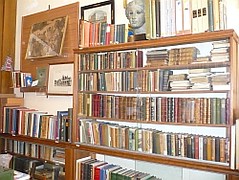
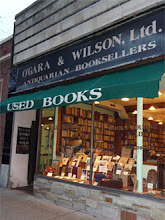
Many of you have been to our store before. No doubt you are acquainted with the monk who sits serenely at the rear, and the ill-fated buffalo whose head hangs just above the beginning of American History (no coincidence, that). What, one might ask, do these two members of O'Gara and Wilson have in common with Douglas Wilson, owner of this venerable institution? What spiritual kinship inspired him to recruit such unusual allies in the bookselling battle?

Let me put your curiosity to rest. The Scriptorium monk represents care for the printed page, a connection with times long past, when an author's text required the hand of a craftsman for its completion. In the mid-1800's book-binding machines began to catch on, slowly reducing the concept of "book" to nothing more than an efficient means for distributing ideas. Mr. Wilson and Jerome, as he is fondly called, still cherish the idea of book as artifact, something the significance of which depends not merely on the meaning of the words within, but is continually shaped by all those who share in its history, from the author to the customers that frequent second hand bookshops.

And the buffalo? Both he and Mr. Wilson represent what biologists refer to as a “keystone species.” A keystone species has a disproportionately important effect on its surroundings. Though its presence may be small in terms of population, the existence of a keystone species is crucial for sustaining diversity of life in its environment. When such a species goes extinct, the ecosystem that it supports falls apart, like a bridge whose keystone has been removed. Mr. Wilson and the store he runs are a powerful if subtle force, shaping the Hyde Park community and consequently the world. Luminaries like author Saul Bellow and theologian David Tracy have found fuel for their intellectual furnaces here, at this well-stocked woodpile of ideas, whose logs are daily gathered, bundled, and delivered by the bibliotaph (one who caches or hoards books) of whom we speak. Not to mention the many others who pass through our doors, hoping to stumble upon some synchronicity that radically changes their perspective. One can only imagine what would happen to the diversity of life and thought in Hyde Park if O’Gara and Wilson were to be replaced by, say, another Borders.

And that brings me to the most important part of this blog, namely the crucial difference between Mr. Wilson and these two fixtures of his bookstore. Not only is he still alive, but Mr. Wilson plans on continuing to thrive. He will not bow to the cultural forces that escorted monastic scribes and majestic herds to their respective graves. This keystone species, at least, is fighting and winning. The used bookstore’s struggle to survive can take many forms. Mr. Wilson is unique in that he employs a three-pronged approach. In fact, he himself has suggested the metaphor of a three-legged stool. This term was supposedly coined by Oxford scholar Rev. Richard Hooker, in reference to the Anglican church (sorry, Jerome) and the three legs that support it: scripture, reason, and tradition. Our elements are humbler, but no less important to stability. They are high-end auctions (Collectible), in-store sales (Favorite), and the internet (Affordable and Interesting).

Most people don’t know it, but much of the bookstore’s revenue comes from consigning very collectible books and items to auction houses. These venues have an international audience, ranging from university libraries to enormously wealthy private collectors. Here are some examples:

http://www.swanngalleries.com/index.cgi

http://www.bonhams.com/

While your average walk-in customer may not have the necessary liquidity to purchase Shakespeare’s hand-written first draft of Romeo and Juliet (originally entitled Romeo and Bernice, it appears), auction houses allow Mr. Wilson to distribute such items through the proper channels.

But whence these auction-worthy artifacts? Is Mr. Wilson some sort of latter-day treasure hunter, digging under every Hyde Park oak until he discovers the secret stash of an eccentric Shakespeare scholar? Do kind souls simply drop box upon box of their Loeb classics on our doorstep? Nuh-uh. Aquiring a truly magical used bookstore inventory is a simple function of customer relations and rapport with fate.

Let me explain. Quite often it is long-time bookstore patrons who provide us with our wares. We have seen books come back through that were once sold by Mr. O’Gara over thirty years ago. Without long-term customer relationships our store would be dead in the water, not only because no one would sell us any books, but also because many people wouldn’t have cool books to sell. Just as often, though, sheer chance seems to bless Mr. Wilson with extraordinary caches of books and objects, although when something chancy occurs on a regular basis it’s usually due to something. But how do you explain this –


.


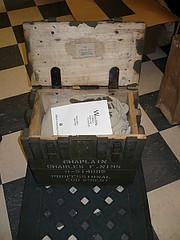
a German hand-grenade storage box, converted by an army chaplain into a container for bibles and altar cloths. Talk about swords to plowshares – and a serious instance of the book as a historical artifact. Good luck finding another one of those, or any of the other strange confluences of events that can be found and purchased at O'Gara and Wilson…
Unfortunately, the gusts of modernity will overturn any two-legged stool. Science and technology vigorously trumpet the demise of feeble furniture: “Physically impossible!” they cry, or “I can buy a three-legged stool for less online!” until the vast majority of two-legged-stool-used-bookstore-hybrids are chopped into metaphorical kindling, to be sold somewhere else, or failing that, to be unceremoniously dumped in the dustbin of history. We have not remained in the Luddite past of unscientific bookstore cavern-people. Like some nuclear accident that results in a positive mutation, we evolved a third leg. The internet.

http://www.abebooks.com/servlet/ListingBrowse?vendorclientid=78077

That links to our online inventory. You may have thought the appearance of these funny stickers around the store had a deep meaning –
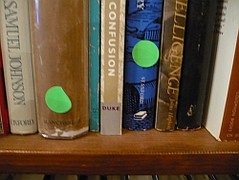


-- discounts, perhaps, or a pox with a tendency to infect more expensive academic texts. Not so. These are the brands of the internet, bright marks of our submission to a new order. Orange dot: book might go online. Green dot: book is online. Some days we sell more books online than we do in the store. Much clerk time goes into putting books online, or searching the internet for prices so we can be the best deal in town (that is generally how we price our books, in line with the lowest online prices). There is a new competitive force; the open market of the internet has changed the face of bookselling. Now a beautiful art book might be worthless because so many were printed, but an expensive Russian calculus book might be salable to a client overseas. There are drawbacks to the internet, but for a store like ours there are also advantages, provided we are ready to use them. Right now, in fact, you are helping us with another aspect of the mutant technological third leg, just by reading this blog. Go on, write in! Let us know you made it this far through the blog! Let us know you’re out there! Come into the store, and say – the blog technology brought me here!

Uh-oh. Things are getting a little out of hand. I think we covered everything we set out to cover – from O’Gara and Wilson, this is cyber-Alan, wishing you a three-legged future with Jerome.

Wednesday, September 17, 2008

To picture or not to picture...

Dear Readers,

The focus of our current blog is a topic close to my heart – the illustrated book. There is no question, of course, that certain types of books benefit from illustrations. One shudders at the thought of a cookbook entirely bereft of pictures, and an art-book without some reproductions of the works it treats seems, at least to me, entirely pointless. But the relative value of illustrating fiction is not so easily decided. Tolkien himself, in his essay “On Fairy-Stories” complains that illustrating such tales deprives children of the opportunity to imagine things for themselves. This, of course, from an author who illustrated the Hobbit himself. While Tolkien doesn’t count the Hobbit as a fairy-story, it seems plausible to extend his argument to all illustrated fiction. Somehow, the act of reading is essentially an imaginative one, and illustrations restrict the reader’s freedom, imposing particular images onto the blank canvas of the text.

I’ve heard people make similar claims about movies – Christopher Tolkien wanted nothing to do with the film adaptations of the Lord of the Rings, saying they were peculiarly unsuited to film, and his father has been quoted as hating all things Hollywood. After watching the cinematic form decimate favorites like The Phantom Tollbooth and The Hitchhiker’s Guide to the Galaxy, some might be inclined to agree. But the issue is more complicated than that. Certain books might be bad material for film adaptation. Others, like Gone with the Wind, Pride and Prejudice, and One Flew Over the Cuckoo’s Nest, do quite well, in my opinion. There is, I think, no standard rule to be applied in this case. Plays, needless to say, are actually meant to be performed – with Shakespeare or Beckett we should have no compunctions about restricting the reader’s imagination with a movie or performance, since the reader is actually meant to be a spectator. A book that has been singled out as impossible for adaptation (Sterne’s Tristram Shandy, for instance), is simply waiting for a talented film-maker to rebut the claim.

So when should something be illustrated, and when should things be left to the reader’s imagination? Do the same rules apply – can a good illustrator always rebut the claim that a book ought not be illustrated? Perhaps. But maybe a different place to start is the general consensus on which audience benefits most from illustrated books. The answer is easy: children. Modern novels tend not to be illustrated – children’s books almost always are. Indeed, the amount of illustration in a book is inversely proportional to the target age group. (Imagine Dr. Seuss without illustrations!!)

At first this trend might appear intuitive. Kids like pictures. They need them to supplement necessarily sparse narratives, and peak their curiosity. Or do they? “When we are very young children we do not need fairy tales: we only need tales. Mere life is interesting enough. A child of seven is excited by being told that Tommy opened a door and saw a dragon. But a child of three is excited by being told that Tommy opened a door. In fact, a baby is about the only person, I should think, to whom a modern realistic novel could be read without boring him.” G.K. Chesterton makes a wonderful point. Children have vibrant imaginations, lacking in most adults, it seems. Not only that, but our modern attention span has dwindled to a pathetic shell of itself – just look at the length of camera shots in recent movies compared with those of a couple decades past. One could make the case that it is adults who need illustrations to help them imagine things more vividly, especially given the rather dry content and increasing length of the reading material they tend to choose.

You may, at this point, be starting to lose patience. It is my hope, in fact, that you are thinking, “All right, all right, enough already. Where are the pictures of the books? That’s why I read this blog.” Because if you are, it would make my argument that much more compelling. The interest of this blog lies in part with the inclusion of pictures, which spruce up the otherwise dreary procession of letters that currently clog your screen. So without anymore boring, intellectual, adult-oriented prose, I offer three books for your consideration. All are illustrated, and they cover a wide enough variety of target audiences for any interested blog readers to come in and settle this question for themselves.

Collectible


.
.


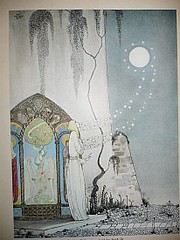
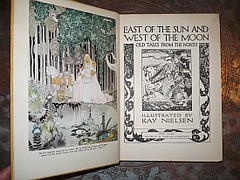
Book: East of the Sun West of the Moon. $200. Target audience: Children (and wealthy adults). Illustrator: Kay Nielsen. One of three greats from the golden age of book design and illustration (Arthur Rackham and Edmund Dulac are the other two). He is my favorite of the three, due to his pronounced Asian influence and particular skill with line drawings. This book of Norse fairy tales showcases, I think, his best work. Absolutely wonderful example of the lavish gift books produced during the first half of the 20th century.

Favorite


.


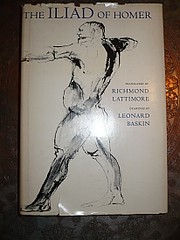
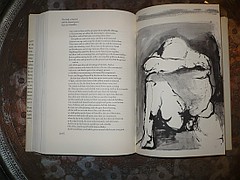
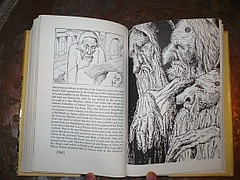
Book: The Iliad. $30.00. Target audience: Adults (and unusually precocious children). Illustrator: Leonard Baskin. Baskin was close to Ted Hughes and Sylvia Plath, among other luminary literary figures. He sculpts and illustrates, and his influence can be seen in modern illustrators like Ralph Steadman. Particularly good at portraits, Baskin’s interpretations are often dark and disturbing. I absolutely love this guy – and I’ll be honest, I need his help to get through Homer. Among Baskin’s greatest works is an edition of Swift’s “A Modest Proposal,” which leads nicely into the final item.


Affordable and Interesting


.


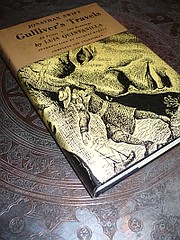
Book: Gulliver’s Travels. $7.50. Target audience: Adults? Children? Illustrator: Luis Quintanilla. Manifestly a book for adults, the fantastical elements of Swift’s “frank and vitriolic satire” (from the dust jacket) are now popularly targeted at children (in abridged editions, a topic for another blog…). Almost every page of this edition is profusely illustrated with Quintanilla’s hilarious black and white prints. A stunning example of graphic art, at a remarkably affordable price.

There you have them. Say whatever you like about the relative merits of book illustration, but make sure your opinion is educated, preferably through a visit to our store.

From O’Gara and Wilson, this is Alan, over and out.

Wednesday, September 10, 2008

Dear Readers,

Part 1: Collectible

“The history of mankind, as a history of the human spirit, may be thought of as consisting of two elements: an escape from this world to another; and a return to it. Chronologically speaking, these two movements, the rise and fall, represent the whole of human history; and the two take place microcosmically many times in peoples and nations…

The nature of haiku cannot be rightly understood until it is realized that they imply a revolution of our everyday life and ways of thinking.

…Haiku record what Wordsworth calls those ‘spots of time,’ those moments which for some quire mysterious reason have a peculiar significance. There is a unique quality about the poet’s state of feeling on these occasions; it may be very deep, it may be rather shallow, but there is a ‘something’ about the external things, a ‘something’ about the inner mind which is unmistakable. Where haiku poets excel all others is in recognizing this ‘something’ in the most unlikely places and at the most unexpected times.”

-- R.H. Blyth (selections from the prefaces)


Flying in by the bamboo-blind,

The swallow is tame

With the beautiful girl.

-- Ransetsu


The kingfisher;

In the clear water of the pond,

Fishes are deep.


--Shiki


In the spring breeze

The snowy heron flies white

Among the pine-trees.

--Basho


.


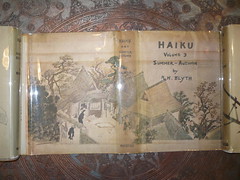
Haiku, 4 volume set of first printings, $200.


Part 2: Favorite

I

Among twenty snowy mountains,

The only moving thing

Was the eye of the blackbird.

II

I was of three minds,

Like a tree

In which there are three blackbirds.

III

The blackbird whirled in the autumn winds.

It was a small part of the pantomime.

IV

A man and a woman

Are one.

A man and a woman and a blackbird

Are one.

V

I do not know which to prefer,

The beauty of inflections

Or the beauty of innuendoes,

The blackbird whistling

Or just after.

VI

Icicles filled the long window

With barbaric glass.

The shadow of the blackbird

Crossed it, to and fro.

The mood

Traced in the shadow

An indecipherable cause.

VII

O thin men of Haddam,

Why do you imagine golden birds?

Do you not see how the blackbird

Walks around the feet

Of the women about you?

VIII

I know noble accents

And lucid, inescapable rhythms;

But I know, too,

That the blackbird is involved

In what I know.

IX

When the blackbird flew out of sight,

It marked the edge

Of one of many circles.

X

At the sight of blackbirds

Flying in a green light,

Even the bawds of euphony

Would cry out sharply.

XI

He rode over Connecticut

In a glass coach.

Once, a fear pierced him,

In that he mistook

The shadow of his equipage

For blackbirds.

XII

The river is moving.

The blackbird must be flying.

XIII

It was evening all afternoon.

It was snowing

And it was going to snow.

The blackbird sat

In the cedar-limbs.

--Wallace Stevens


.


The Collected Poems of Wallace Stevens, 1982 printing, $7.50


Part 3: Affordable and Interesting


Sections on rhythm, and rhyme, and the music of words. Each poem with a sentence to inspire thought about poetic technique.

The Poet’s Craft: Selected Verses, Daringer and Eaton 1935, $10.50

Wednesday, August 27, 2008

Dear Readers,

I sincerely hope the whirlwind of changing blog authors and new employees has not been too dizzying. That said, I must introduce yet another member of our staff. His name is Jerome.


As you have no doubt guessed, Jerome is a monk. He can be seen in this photograph working hard on the ledgers, meticulously copying columns of records in order to... Hold on a moment. I hear a faint voice calling from the back of the store.

Sorry about that. Jerome has informed me that he tires of his mindless drudgery, hour upon hour of the same boring tasks that occupied him at the old Scriptorium. I offered to let him write this week's blog, and he seemed greatly cheered by the prospect. My apologies if the writing is dry or the topic dull. Without further ado...

Dull? Dry? He's got some nerve, that Alan, implying we monks sit around all day discussing how many angels can fit on the head of a pin, or debating the intricacies of Trinitarian doctrine. I'll give you readers a, what do you call it, an Internet Grog, I think Alan said, that's both educational and stimulating.

In fact, speaking of grog, you should know that many monks like myself specialized (and still specialize) in the brewing of beer. We've been a fun-loving bunch for ages. Hopped barley beer first appeared in the charter of a Benedictine abbey in 768. Water was often contaminated, and beer provided a safe alternative beverage, since boiling is a step in the brewing process. The quality of this fine product improved generation after generation, and eventually brought fame to monastaries. Over 500 monastic breweries existed by the year 1000, producing beer both for sale and consumption by their members (a slightly weaker version was even developed for nuns). Of course, some stick-in-the-mud monks have tried to curb this habit -- pun observed but unintended. In 1664, the Abbot of La Trappe felt things were getting a little too liberal, and passed the Strict Observance, permitting only water to be drunk at the monastery. Needless to say, righteous monks like myself were loath to comply, and I have it on good authority that many disobeyed the regulations and continued to brew tasty beer in secret. This is no longer necessary, thank goodness, as the rules have been relaxed considerably since then.

Ironically, monastic beers experienced an explosion in popularity and quality during the 1920's and 30's, precisely when this nation enacted its own Strict Observance. Of course, if monks were unable to desist from beer making and drinking, Americans were even less likely to do so. Alcohol thrived during Prohibition, and the main character in this week's Collectible was accused of making his fortune in bootlegging.


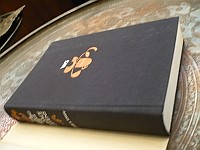
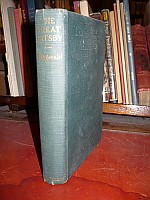
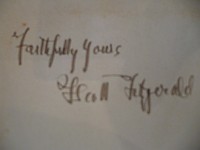
Jay Gatsby -- monk at heart? Alan has been reading over my shoulder, and insists I mention the fact that this is a first edition of The Great Gatsby. Of course, at the Scriptorium, all editions were first editions, since they were copied by hand, but that's another matter. So there you have it, a first edition of the Great Gatsby, excellent reading for those who are interested in life during America's time of Strict Observance. Needless to say, F. Scott Fitzgerald did not observe strictly. He was a heavy drinker, and it interfered severely with his writing later in life. In fact, if you look closely at the photograph below, you might see a slight shakiness in his signature.

Yes, that is F. Scott Fitzgerald's signature, in a copy of his Flappers and Philosophers. These two books are priced at $1950 and $6500 respectively. Drink some good Trappist ale and perhaps you'll be less reticent to make the purchase.

If your tastes run more towards beer than literature, as mine do, you will probably be tempted by the Affordable and Interesting items this week.


Practical Points for Brewers was published in 1933, the year that Prohibition ended. Along with this fine volume there are scores of advertisements, pamphlets, beer-brewing manuals, and other printed material of related interest available for purchase. Prices range from $5 for one page ads to $75 for the scarcer books. They provide a wonderful window into the world of early 20th century American beer and alcohol. Personally, however, I wouldn't use the reference materials to actually brew beer -- I borrowed one of the volumes, followed the instructions rigorously, and came up with some pig-swill that I wouldn't wish on the man behind the Strict Ordinance. A friend of mine said it tasted a good deal like Miller High Life, which makes sense -- in 1933, Miller dispatched a case of said beer to President Roosevelt, celebrating the repeal of the 18th Amendment. Knowing this makes me feel better, since it means the poor quality was the fault of the method, not the brewer. Alan is again reading over my shoulder, and wants me to add that the thoughts and opinions expressed in this grog (sorry, blog, I'll get it straight from now on, thanks Alan) belong solely to the author. Alan himself is a fan of Miller High Life.

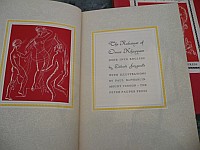
With all this talk of alcohol, and the mention of Mr. Fitzgerald, it is fitting to mention one of the most eloquent testaments to the beauty of drinking, though The Rubaiyat of Omar Khayyam concerns wine, not beer.


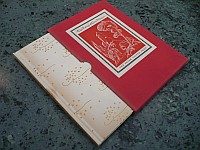
Translated by Edward Fitzgerald, the poem beautifully twines drinking and living: "So when that Angel of the darker Drink / At last shall find you by the river-brink, / And offering his Cup, invite your Soul / Forth to your Lips to quaff -- you shall not shrink." I shall not shrink, thank you very much. This particular edition, and the Favorite of the week, combines my greatest loves -- good drinking, divinity, and quality bookmaking. Peter Pauper Press produces quality, affordable books ($6.00 for the one pictured here). Interestingly, despite his fame as a translator of this poem, Edward Fitzgerald did not resemble the later F. Scott in his actual drinking habits -- in fact, he was a vegetarian who destested vegetables, and subsisted entirely on a diet of bread, fruit, and tea. Perhaps he didn't pay close enough attention to the meaning of what he was translating -- a mistake often made by scholars.

Well, that brings me to close of this week's blog. Now it is up to Alan to type it up -- any spelling errors are his fault, not mine (just check the original manuscript if you happen to drop by). From O'Gara and Wilson, this is Jerome, over and out.

Wednesday, August 20, 2008

Up Front and Personnel

Dear Readers,

Allow me to introduce a blog entry concerned with introductions. Recently, new forces have been introduced at O’Gara and Wilson, forces that are redefining the store from top to bottom, back to front. It would be an admirable day’s work if we could cover one of those areas -- I propose starting with the front.

Most importantly, there are new faces to be seen there. Sarah and Kim are now a part of the staff, helping in our mission to exchange one type of printed material for another. Lest you underestimate the power of their presence for this institution’s feng-shui, witness another significant change to the storefront, due in no small part to their efforts. Alongside Helena, these two dedicated craftswomen reshaped the glass cases, sculpting a thing of beauty that rivals any of its component parts.


Organized by topic: done. Arranged by size: done. Sorted by aesthetic appeal and age: done. In honor of their efforts there will be a ONE-WEEK SALE on the choicest Collectibles we have to offer. From the opening chime of the register on Saturday, August 23rd until the thump of the deadbolt next Friday evening, every single item in the glass cases will be discounted 10%.

Wait just one moment, you say. Hold on. What about the really high-end stuff? What about the signed T.S. Eliot, say, or the first folio Shakespeare? Surely those are not 10% off?

Do you think Mr. Douglas Wilson, owner and moral backbone of O’Gara and Wilson, would ever allow the electric ambassador of his business to disseminate deception? Never! First of all, the signed T.S. Eliot will absolutely be discounted 10% -- either one (yes, we have two). As for the first folio Shakespeare. We don’t have a first folio Shakespeare, and I never claimed we did. But for those that got their hopes up, rest easy. The Norton facsimile first folios partake of the same discount as every other item – either one (yes, we have two).


And they are much more reasonable -- $125 regular price, so you do the math.

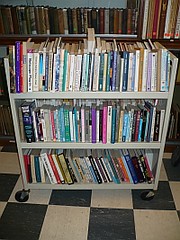
Now that we’re up in front by the glass cases, I should mention a new policy introduced by the city. No longer is the beloved bargain book cart allowed to make its daily pilgrimage to the sidewalk. Chicago, ever thoughtful and clear-headed about the orderliness of its streets, has informed us via local agents that a fine will attend any such excursion. In protest of this unjust imprisonment, the week’s Affordable and Interesting item is taken from this humble cousin of the glass cases.


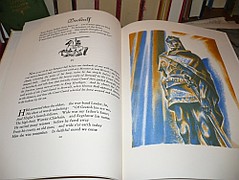
As you may or may not be aware, every paperback on the cart is $1, and every hardback is $1.50. Big deal, right? That’s where bookstores put all the crap they can’t sell… Think again, my friend, because things don’t work that way here at O’Gara and Wilson. Ask any of the book dealers who occasionally go treasure hunting through the contents of the cart. Or examine this gorgeous copy of Beowulf, illustrated in color and black and white by Lynd Ward, plucked freshly from the top row of bargain books. That’s right, only $1.50.


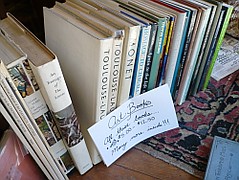
Of course, without the cart our window will have time to shine. Here you can see an assortment of high-quality art books featured there, all priced between $5.00-12.50.


The sign suggests more such treasures inside. Again, you may think we cannot resist exaggerating the extent of our selection – perhaps most of the books inside are paperback, or more expensive than those in the window. This week’s Favorite will put to rest any such notions, while simultaneously facilitating another introduction, this time one of my favorite illustrators.


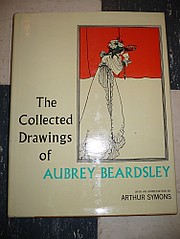
Aubrey Beardsley does extraordinary work, some of it playful, some fantastical, some erotic, and nearly all of it intricate and beautiful. I found a wonderful book of his collected drawings inside on the shelf, when I was looking to verify the claim of our storefront sign. Price: $6.50.

Just to review this week’s key points: New employees -- Kim and Sarah. Glass cases sale -- Saturday the 23rd to Friday the 29th, everything 10% off. Front of the store -- changed, invigorated, and well worth a visit. From O’Gara and Wilson, this is Alan, hoping the conclusion of these introductions can be in person.

Wednesday, August 13, 2008

Indignant Ruminations

Readers of the Blog,

It is both a privilege and a duty (the latter far less present to my mind than the former, of course) to take over this magnificent means of communication from my erstwhile, stalwart, and winsome co-worker, the one known to most simply as "Lydia", and to a few as "Lydia, supreme leader and benevolent bestower of order and organization."

I hope I don't screw it up.

See, while Lydia may appear to be kind, big-hearted, magnanimous, even-tempered and level-headed, it is a fact that she will not let mistakes go. Recently, she built an extremely minor error of mine into the very fabric of our store. My irresponsibility, immortalized. I quote from the updated edition of our employee manual (censored for security purposes): “The camera is kept in a ____ beside the ____ _____, along with its manual and installation CD (note – manual and installation CD were mislaid by Alan, possibly at home – keep reminding him to keep an eye out for them; but remember that you don’t actually need to have the camera program installed to retrieve the photos – the computer can take them off the camera automatically).”

Mislaid by Alan??!! What if they are found? Do I have permission to exonerate myself by altering the instructions? Should I still be stamped with the proverbial scarlet letter, for my malfeasance? What if they aren’t found? Am I doomed to receive phone calls from the mystified employees of O’Gara and Wilson fifty years hence, when CD’s don’t even exist, and the only discernable information in that sentence will relate to the fact that I committed an indiscretion? Why does it matter, since the manual and CD are, by the author’s very own admission, unnecessary?!!

Forgive me, I got carried away. It won’t happen again, I promise. As Lydia pointed out in her previous blog, the tone of my writing will be less Victorian, more thematic. Less chatty, more down to business. I shall have no truck with wordy digressions, lengthy meditations, and spurious fabrications. "Gentle readers?" she used to call you? Hah! You better toughen up, blog-reading softies, fed too long on the soft soup of Lydia's molly-coddling. More like "hardened readers," by the time I'm through with you. Nothing but straight-shooting information about the most ridiculous things that crop up in this store. No punches pulled, no absurdities omitted. Feverishly strange and morally objectionable objects will be our standard fare. Lydia will have no more mistakes to criticize, nothing to seize upon and commit to the computer’s ever-pulsing memory circuits.

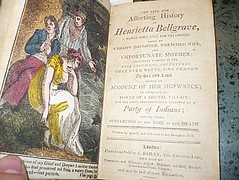
Let's see what we've got this week. My lord! It's a story detailing what could happen to me or those miserable blog readers who can't hack it, here in the real world of ruff n' tuff blogging. Lemony Snicket cover your head in shame! Job, count your blessings. Ladies, gentleman, and all people stout of heart, this week's Collector's Item is: "The True and Affecting History of Henrietta Bellgrave, A Woman Born Only for Calamities, Being an Unhappy Daughter, Wrteched Wife, and Unfortunate Mother: Containing a Series of the Most Uncommon Adventures that ever Befel one Person by Sea and Land, Giving an Account of her Shipwreck; her falling into the Power of a Brutal Villian; and her Being Providentially Relieved by a Party of Indians; with her further Sufferings to the Time of her Death."


Indeed. For $600 you can own this unfortunate saga, bound in leather together with no less than 5 other similar chapbooks, each preceded by a hand-colored engraving. These are followed by a comedy in five acts, from the pen of Shakespearean opera-writer Frederick Reynolds, entitled "The Dramatist; or Stop Him Who Can." All date from the early 1800's and were published in London. There is nothing remotely like this volume available online. Don't pass it up, lest you feel like Henrietta some years down the line for having missed such a unique opportunity.

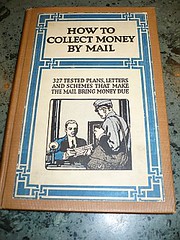
Ah yes... some of you may be calloused from watching television and playing violent video games. Perhaps poor Henrietta's travails do not curl your toes or stand your hair on end (while the price does more than its share of both). Well, I promised morally objectionable, and morally objectionable you’ll get. Maybe with the aid of this week's Affordable and Interesting item you'll be able to afford the chapbooks listed above. See, with only a little willingness to overlook ethical strictures, this book will pay for itself. Published in 1913, "How to Collect Money by Mail" is a mint condition copy of 327 Tested Plans, Petters and Schemes that Make the Mail Bring Money Due.


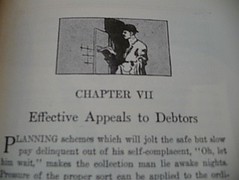
A mere $12.50 buys you the means to make millions upon millions. Well, not exactly. What this book will allow you to do, however, is act as an effective collection agent. If you have some vagabond friend who constantly fails to pay you back, or in the unlikely event you are actually an old-time collection agent who still operates by writing persuasive personal letters, chapters on "Rousing the Will to Pay" and "Handling Collections Through an Attorney" will certainly be useful, if not somewhat dated. We have all read it here at the store, so if anyone is tempted to pay with a bad check, think again. We'll get our money by hook or by crook (usually by crook, since our hook is rather large and unwieldy).

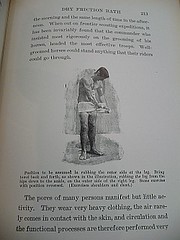
Whew. At this point you might be feeling tired, sapped, drained, winded, wearied, listless. So much reading, so much activity, it's all too much, just like it is at the end of your work-day. Most people nowadays can't handle high intensity exertion, physical or mental. No matter, that's nothing I wasn't able to solve for myself, with the aid of Bernarr MacFadden, author of this week's Favorite. In 1904 he did everyone the incredible favor of publishing his classic "Building of Vital Power." As he asks so eloquently in his Preface: "My friends, do you realize the meaning of VITAL POWER? Have you ever experienced that super-abundance of health which breeds an intense satisfaction with life and all living things? Have you ever felt the supreme joy of mere existence? The satisfaction of that makes you exclaim: 'There is indeed zest in life!' "


Chapters cover everything from "Vast Importance of Water" to "Erroneous Methods of Breathing," including a section on the "quiet breathing used by weaklings." Take note. Purity of essence and precious bodily fluids are all safe once you've internalized MacFadden's philosophy. All you need to do is externalize $15 in the presence of one our clerks, and the opportunity is yours.
Short and to the point, just like I said. It has been a pleasure, and I hope you will join us again here next week. Wonders and mysteries await. From O'Gara and Wilson, this is Alan, over and out. And everyone: three cheers for Lydia. She will be missed.

Wednesday, July 23, 2008

"Eggs must not quarrel with stones", dear readers.

Gentle readers, I have two meaty bits of news for you to set upon like terriers. The first bit is that the bookstore shall be closed from this coming Sunday, July 27, through Saturday August 9; we will reopen on the 10th, doubtless to cheers! During that time we will all be relaxing on the beach, and so should you be. (Obviously, there will be no blog entries written for the next two weeks.)

The second bit is that I will be scaling back my involvement in this wonderful bookshop, becoming something of a rarely visiting but tyrannical consultant-like figure as I get the rest of my life in order, and as a result I -- Lydia -- will no longer write most of our blog entries! I weep, dear readers, truly I weep. The hilarious Alan will replace me on a regular basis, so you can look forward to blog entries with less of a Victorian tone and more coherent themes.

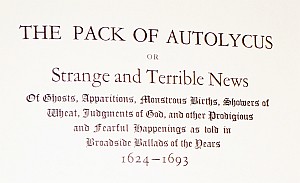
No longer writing the blog! Dear readers, it is like an omen or a portent -- something like what's recorded in this Affordable and Interesting little tome:


In case you cannot read that Gothic lettering, the tagline of this book reads: "Strange and Terrible News of Ghosts, Apparitions, Monstrous Births, Showers of Wheat, Judgments of God, and other Prodigious and Fearful Happenings as told in Broadside Ballads of the Years 1624-1693". Now I knew that a "broadside" is a term referring to excitable poster-like sheets of paper, splashed about the town; what I did not know is that once upon a time, all broadsides recorded ballads, and were sold for a pittance by musicians. (You can see some images and such from old broadsides at the Bodleian Library's website: click here!) It would seem that this book chronicles a particular collection of broadside ballads (that of Anthony Wood, a medieval gentleman who essentially kept a scrapbook of the things), and that his collection particularly featured tales of strange and marvelous occurrences. For instance, one page has this woodcut:


... accompanied by a rather involved set of verses covering many lands, including:
In Anno sixteene hundred and eighteene,
A blazing Starre was o'er Bohemia seene,
Which for the space of seven and twenty dayes,
Within the sky most fearefully did blaze.
And in Hungaria (as 'tis understood,)
Water was Metamorphos'd into bloud.
In Brunswick-land (within an evening faire,)
Were seene two armies fighting in the aire.


Intrigued? Me too! $12.50, and who knows what you might discover of our supernatural past?!

Supernatural influences are pernicious and subtle. I think that some must have been at work in these Collector's Items:


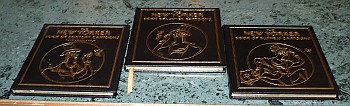
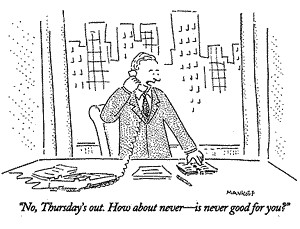
You see, the Easton Press produces elegantly leather-bound books with gilt detailing and gilt edges; editions that will last a long time, and look nice to boot. In the past I have mostly seen books chronicling American presidents, or famous classic books, from the Easton Press. But it seems that some odd supernatural influence has caused them to branch out ... into things like "New Yorker" cartoons! (I see from their site that they are also selling the classy How to Be A Betty: Unleashing Your Inner Boop... what is the world coming to?) At any rate, here lie collections of "New Yorker" comics (as hilarious as ever) on the subjects of Doctors, Lawyers and Business -- $75.00 apiece. The gilt detailing on these particular Easton editions features the famous New Yorker monocle theme: gilted doctor with monocle, lawyer with monocle, and businessman with monocle. And if you get the Business one, you will gain one of the most legendary "New Yorker" cartoons ever:


I wish all my comic books were bound in elegant leather!

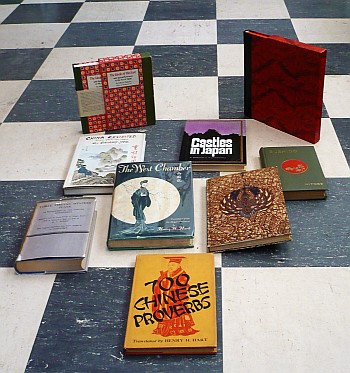
But my Favorite this week, and possibly for all time, is not comics or strange phenomena or leather; it's the entire incredible Asian Studies collection that we're getting in right now.


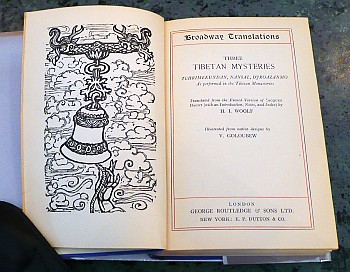
We've only just begun processing these books, and they are absolutely marvelous! We have had to dramatically expand our sections on Miscellaneous Asian Countries, China, Chinese Art, Japan, Japanese Art, India / Pakistan, Eastern Religion / Philosophy, and Middle East / Islam -- just to fit all the remarkable books that we're getting. And there's more to come! Our Asian Studies section will be completely incredible for some time, gentle readers, I assure you -- here you see a mere sampling of the material we worked with today. First we have some quite scholarly titles on subjects like Asian literature, psychological theories, education, and all manner of more specific subjects -- such as the above-pictured book on Japanese castles, which I might just kill for (or buy for $10.00). Then there's various kinds of art in translation; Three Tibetan Mystery Plays: As Performed in the Tibetan Monasteries is one of the most obscure and fascinating examples ($35.00):


And then there's some random items, such as this charming little collection of translated Chinese proverbs:


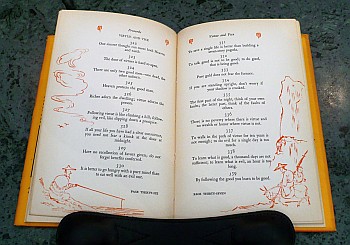
$12.50 gets you all of the following and more!:
* He who only comes from upstairs is a guest.
* Don't ask a guest if you may kill a fowl for him.
* He is truly a superior man who can watch a chess game in silence.
* Eggs must not quarrel with stones.
* A divided orange tastes just as good.


I am thinking that I may be unable to leave the store. I may simply sit in the Asian Studies area and read. For the rest of my life. You mark my words! My beard will grow long and my sight will dim before I can tear myself away from these books ... probably.

Thank you for being an appreciative audience, my dearest readers. I will return perhaps as a guest star, and see you all around!